A three-bedroom house needs at least 1,000 gallons under five of the seven state rules we read, and 900 gallons in Pennsylvania and Florida. Texas’s minimum drops to 750 gallons for a three-bedroom house under 2,500 sq ft with water-saving fixtures. Four bedrooms is where the rules split: anything from 1,000 gallons in Washington to 1,500 in Minnesota. For a three-bedroom house, a garbage disposal adds 25 to 50% in three of them. The calculator on this page applies each state’s own table to your bedrooms, floor area and fixtures and shows the range across all seven. Every result is a minimum and an estimate. The office that issues your septic permit sets the real size. For how tanks, drain fields and soil tests fit together, see our sizing and how it works hub.
Minimum tank size by bedrooms in seven states
We read each state’s rule on 3 November 2026 (Florida on a reproduction of the rule; see its note below). Here’s what each one requires for a house with no garbage disposal and no sewage pump:
| Bedrooms | WA | MN | NY | PA | TX | NE | FL |
|---|---|---|---|---|---|---|---|
| 1 or 2 | 1,000 | 1,000 | 1,000 | 900 | 750 | 1,000 | 900 |
| 3 | 1,000 | 1,000 | 1,000 | 900 | 1,000 | 1,000 | 900 |
| 4 | 1,000 | 1,500 | 1,250 | 1,250 | 1,250 | 1,250 | 1,050 |
| 5 | 1,250 | 1,500 | 1,500 | 1,400 | 1,250 | 1,500 | 1,200 |
| 6 | 1,500 | 2,000 | 1,750 | 1,550 | 1,312.5 | 1,750 | 1,350 |
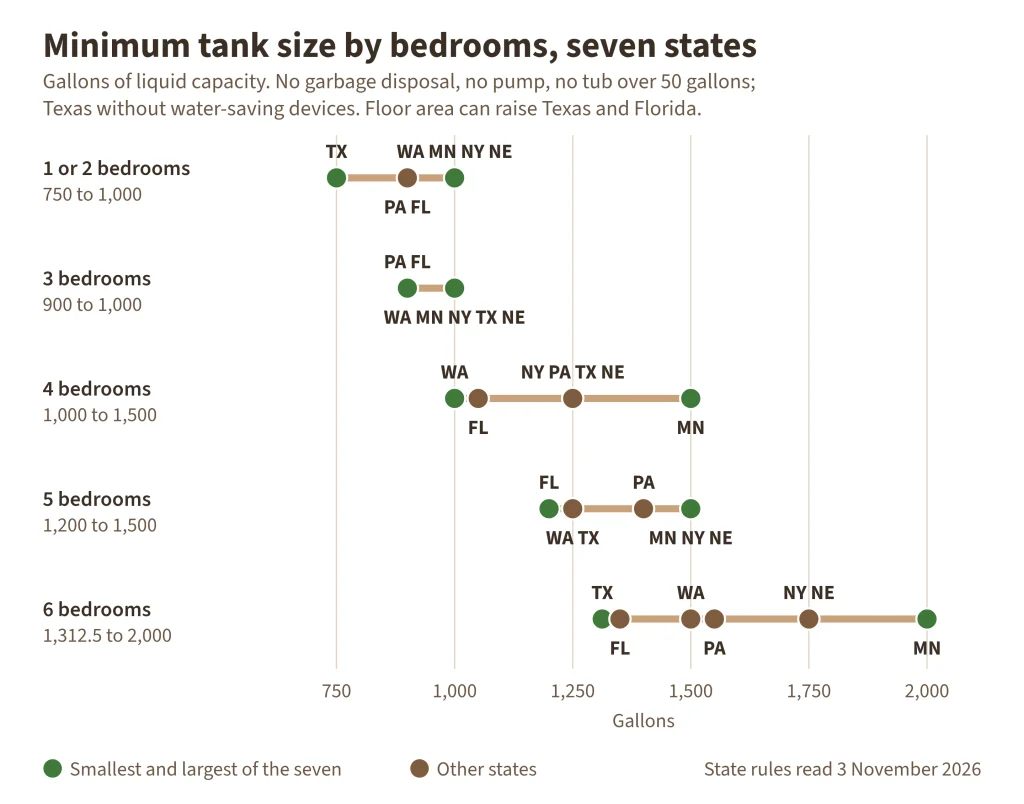
No two of these states use the same table. Washington, Minnesota and New York go by bedrooms alone. Pennsylvania, Nebraska, Texas and Florida first convert bedrooms (and in Texas and Florida, floor area) into a daily design flow, then size the tank from that flow. That’s why the same four-bedroom house can need 1,050 gallons in Florida and 1,500 in Minnesota.
Treat the “1,000 gallons for three bedrooms” rule of thumb with care. It matches five of these states, is more than the minimum in two, and falls short once a disposal is added in Minnesota, New York or Nebraska. Some cost sites print smaller sizes still: Angi’s septic cost page lists a 500-gallon tank for one bedroom and 1,000 gallons for three or four bedrooms. That’s below every one-bedroom minimum here and below six of the seven four-bedroom minimums.
How the calculator works, with a worked example
The calculator doesn’t use a national formula, because there isn’t one. EPA says septic systems are regulated by states, tribes and local governments, not the federal government. Instead it runs seven state rules side by side:
- It works out the minimum under the state you pick, using that state’s table and its add-ons for disposals, pumps and large tubs.
- It runs the same house through the other six rules.
- It reports your state’s figure, plus the smallest and largest of the seven. If your state isn’t listed, the range shows how much the answer can move between states. It won’t tell you your state’s rule.
Take the calculator’s starting example: a three-bedroom, 2,000 sq ft house in New York, with no garbage disposal, no pump and no oversized tub.
- Washington: four bedrooms or fewer, so 1,000 gallons
- Minnesota: three bedrooms or fewer, so 1,000 gallons
- New York: one to three bedrooms, so 1,000 gallons
- Pennsylvania: design flow 400 gallons a day, so (3.5 × 0) + 900 = 900 gallons
- Texas: three bedrooms under 2,500 sq ft is 300 gallons a day, and 251 to 350 gallons a day needs 1,000 gallons
- Nebraska: 100 + (100 × 3) = 400 gallons a day, so 1,000 gallons
- Florida: three bedrooms and 1,201 to 2,250 sq ft is 300 gallons a day, so 900 gallons
The calculator shows 1,000 gallons for New York and a range of 900 to 1,000 gallons across the seven rules.
Now make it four bedrooms with a garbage disposal in Minnesota. Table V gives 1,500 gallons for four or five bedrooms, and the disposal adds 50%: 1,500 × 1.5 = 2,250 gallons, in more than one compartment or tank. The same house needs 1,000 gallons in Washington.
What each state’s rule says
Washington
WAC 246-272A-0232, Table VII: 1,000 gallons for four bedrooms or fewer, plus 250 gallons for each extra bedroom. The tank must have at least two compartments, with the first holding one-half to two-thirds of the total, either in one tank or two tanks in series. This version took effect on 1 April 2025, so check the date on any older copy you find. The rule adds nothing for a garbage disposal.
Minnesota
Minn. R. 7080.1930, Table V: 1,000 gallons for three bedrooms or fewer, 1,500 for four or five, 2,000 for six or seven and 2,500 for eight or nine. Above nine, add 250 gallons a bedroom. A garbage disposal raises the minimum by at least 50% and requires multiple compartments or tanks. So does a sewage ejector or grinder pump that pumps sewage from the house into the tank. If a house has both, the rule says the two increases “need not be additive”, so it’s still 50%.
New York
10 NYCRR Appendix 75-A.6, Table 3 (the Department of Health’s copy, effective 2016): 1,000 gallons for one to three bedrooms, 1,250 for four, 1,500 for five and 1,750 for six, plus 250 gallons for each bedroom over six. A garbage grinder counts as one more bedroom and also calls for a dual-compartment tank or two tanks in series, and an expansion attic counts as a bedroom too. The appendix covers residential systems taking less than 1,000 gallons a day and sets the state’s minimum standards; it says local health departments and other agencies may set stricter ones, and then the stricter standard applies (75-A.1 and 75-A.2). DOH marks its copy as an unofficial compilation.
Pennsylvania
25 Pa. Code § 73.31: no tank may be smaller than 900 gallons. A single-family house is designed for at least 400 gallons a day, plus 100 for each bedroom over three. Up to 500 gallons a day, the tank is 3.5 × (flow over 400) + 900. From 500 to 5,000 it’s 1.5 × (flow over 500) + 1,250. That gives 900 gallons for three bedrooms, 1,250 for four, 1,400 for five and 1,550 for six. These match the table in Penn State Extension’s septic pumping guide. The code says the 400-gallon flow already allows for garbage grinders, washing machines, dishwashers and water softeners, so Pennsylvania adds nothing for a disposal.
Texas
30 TAC § 285.91, Tables II and III, as printed in TCEQ’s rules compilation RG-472 (May 2017). Table III gives a daily usage rate by bedrooms and living area, with a lower column for homes with water-saving devices: 225 gallons a day (180 with water-saving devices) for one or two bedrooms under 1,500 sq ft; 300 (240) for three bedrooms under 2,500 sq ft; 375 (300) for four under 3,500; 450 (360) for five under 4,500; 525 (420) for six under 5,500. Above 5,500 sq ft, add 75 (60) for each extra 1,500 sq ft or part of it.
Table II then sizes the tank: 750 gallons up to 250 gallons a day, 1,000 up to 350, 1,250 up to 500, 2.5 times the flow from 501 to 1,000, and from 1,001 gallons a day, 1,750 plus 0.75 times the flow. A six-bedroom house at 525 gallons a day works out to 1,312.5 gallons, which the calculator shows rounded to 1,313.
Two points take judgement, and the calculator states both. First, Table III pairs each bedroom count with an area limit but doesn’t say what happens when a house is over it. TCEQ’s aerobic unit sizing table, printed with the septic formula in Table II, does: a house with fewer bedrooms but more floor area moves to the larger row. The calculator applies the same step to the septic usage rates, which is our assumption, so a 2,600 sq ft three-bedroom house uses the four-bedroom rate and needs 1,250 gallons. Above 5,500 sq ft it adds each 75-gallon step to the six-bedroom rate, also our assumption. Second, the rules we read don’t define “water-saving devices”, so ask your designer whether your fixtures count.
Cornell’s copy of § 285.91 dates its last amendment to 6 July 2023. TCEQ’s 2023 proposal described the Table II change as one for aerobic units in small homes, and it reprints the septic tank formula and the Table III household rates with the same figures as above. We couldn’t open the current Table II graphic itself. Texas is also rewriting its on-site sewage rules (30 TAC Chapter 285). As of November 2026, TCEQ’s rulemaking page still described the first draft as upcoming.
Nebraska
Title 124 and NDEE’s septic tank general permit GTS220000, both in the Title 124 booklet (version 02.2026). A single-family home is designed for 100 gallons a day plus 100 a bedroom. Table 3 then gives the tank: never less than 1,000 gallons, 1,250 for four bedrooms (500 gallons a day) and 250 more for each further bedroom. Homes with a garbage grinder or a “large capacity tub” use a larger column, and homes with both use the largest: for three bedrooms that’s 1,000, 1,250 and 1,500 gallons. A large capacity tub is any bathtub or similar fixture holding more than 50 gallons. A single-compartment tank must be 50% larger when a pump delivers sewage into it. The calculator applies that 50% whenever you tick the pump box (our assumption of a single-compartment tank), so it may overstate the minimum if your tank has more than one compartment. A garage floor drain connected to the system adds at least 100 gallons a day to the design flow (Title 124, Chapter 8), which the calculator doesn’t include.
Florida
Fla. Admin. Code 62-6.008, Tables I and II, read on Cornell’s copy of the rule. Florida’s official rules site lists the latest final version as effective 16 July 2013, and Cornell’s copy carries the same amendment history, ending in 2013. Cornell also notes that a version adopted through the Florida Administrative Register of 17 May 2022 “is not yet available” on its site. We didn’t open the official rule text, a Word file, so check these figures with your county health department. Table I sets the daily flow by bedrooms and building area: 100 gallons a day for one bedroom up to 750 sq ft, 200 for two bedrooms up to 1,200 sq ft, 300 for three up to 2,250 sq ft and 400 for four up to 3,300 sq ft. Each further bedroom, or each further 750 sq ft or part of it, adds 60 gallons a day, and whichever gives the larger flow applies. Table II then gives 900 gallons up to 300 gallons a day, 1,050 up to 400, 1,200 up to 500, and so on. Tanks must have more than one chamber or be placed in series.
In Florida, floor area can outweigh bedrooms. A three-bedroom house of 3,400 sq ft is 100 sq ft past the four-bedroom area band, so it adds 60 gallons a day. That’s 460 gallons a day, which needs 1,200 gallons rather than 900.
Garbage disposals, pumps and big tubs
The states treat these three very differently. For a three-bedroom house with a garbage disposal:
| State | Without disposal | With disposal | How the rule handles it |
|---|---|---|---|
| Minnesota | 1,000 | 1,500 | At least 50% more, in multiple compartments or tanks |
| New York | 1,000 | 1,250 | Counts as one more bedroom, with two compartments or tanks |
| Nebraska | 1,000 | 1,250 | Uses the grinder column of Table 3 |
| Pennsylvania | 900 | 900 | Already in the 400-gallon design flow |
| Washington | 1,000 | 1,000 | No disposal rule in WAC 246-272A-0232 |
| Texas | 1,000 | 1,000 | No disposal rule in Tables II and III |
| Florida | 900 | 900 | No disposal rule in 62-6.008 |
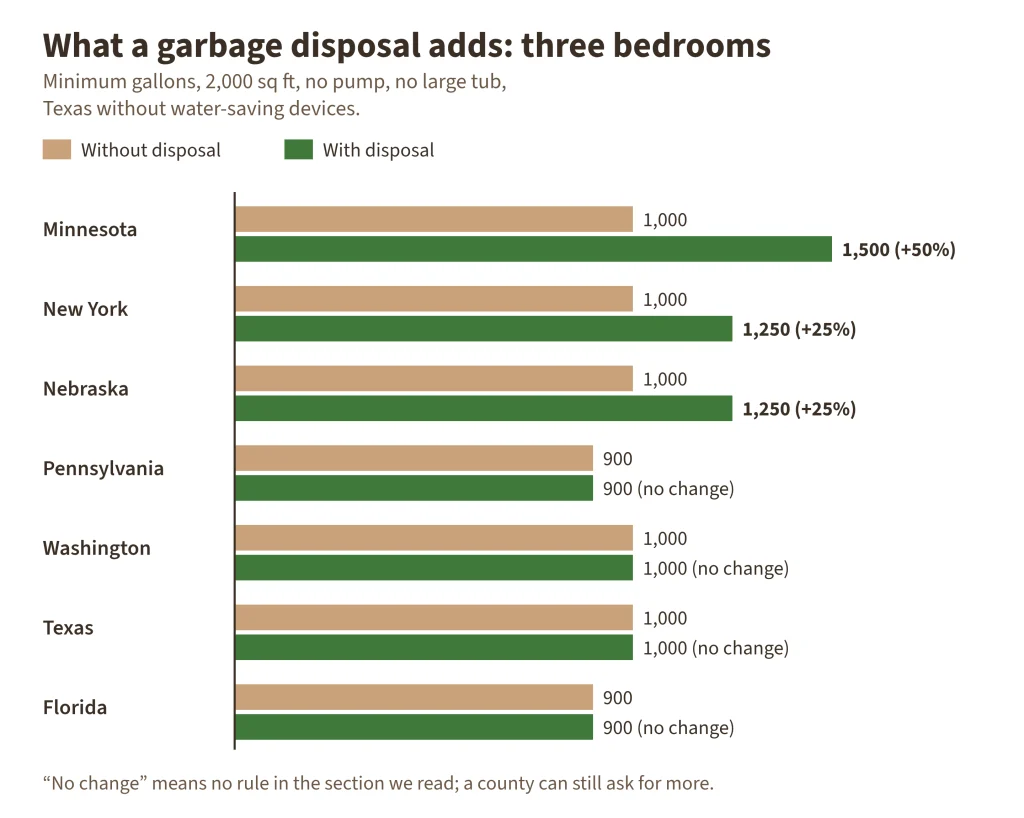
“No rule” in this table means none in the section we read. A county can still ask for more, and a designer may add capacity anyway. Whether a disposal is worth having on septic at all is a separate question, covered in our guide to using a garbage disposal with a septic tank.
Don’t mix up a grinder pump with a garbage disposal. A grinder pump or sewage ejector lifts sewage from a basement or low fixture up to the tank. Minnesota adds 50% for one, and Nebraska adds 50% for a single-compartment tank. We found no such increase in the other five states’ sections we read, so the calculator adds nothing there.
Why the rules count bedrooms, not people
A tank is built for the life of the house, not the family living there now. Bedrooms are a stand-in for how many people the house could hold, so every rule here starts from them. Two things follow.
- “Bedroom” is broader than you think. Nebraska’s Title 124 defines a bedroom as “any room within a dwelling that might reasonably be used as a sleeping room”. New York counts an expansion attic as a bedroom. A den with a closet, or a finished basement room, may count where you live. Ask the permitting office how it counts before you settle on a number.
- Adding a bedroom can trigger a permit. In Nebraska, an existing system needs a new permit or general permit coverage if there’s “an adverse change in use such as an increase in the number of bedrooms” (Title 124, Chapter 2, 004.03, in the booklet above). We haven’t read the equivalent rule in the other six states. If you’re planning an addition, ask before you build.

People matter for how often the tank needs pumping, not for its minimum size. That’s a separate calculation in our septic pumping interval calculator.
Is a bigger tank than the minimum worth it?
A larger tank holds more sludge and scum before it needs pumping. Penn State Extension’s guide, linked above, estimates that each adult adds about 60 gallons of solids a year, and that sludge and scum shouldn’t fill more than about 30% of the tank. On those figures, for four adults:
| Tank | 30% of the tank | Solids a year, 4 adults | Years to 30% |
|---|---|---|---|
| 1,000 gal | 300 gal | 240 gal | 1.25 |
| 1,250 gal | 375 gal | 240 gal | 1.56 |
| 1,500 gal | 450 gal | 240 gal | 1.88 |
So each step up stretches the time between pump-outs in proportion. EPA advises pumping when the bottom of the scum is within 6 inches of the bottom of the outlet, the top of the sludge is within 12 inches of the outlet, or sludge and scum together are more than 25% of the liquid depth.
What a bigger tank doesn’t do is shrink the drain field. Nebraska, for example, sizes the absorption area from the design flow and the soil’s percolation rate (Table 5 of the same general permit), not from the tank. The field and soil test usually decide whether a lot works. See how a septic drain field works for that side of the design. A larger tank also costs more to buy and set, and Angi’s pumping cost page lists higher pumping prices for larger tanks. Our septic system cost calculator covers the whole job.
Liquid capacity, compartments and what’s on the label
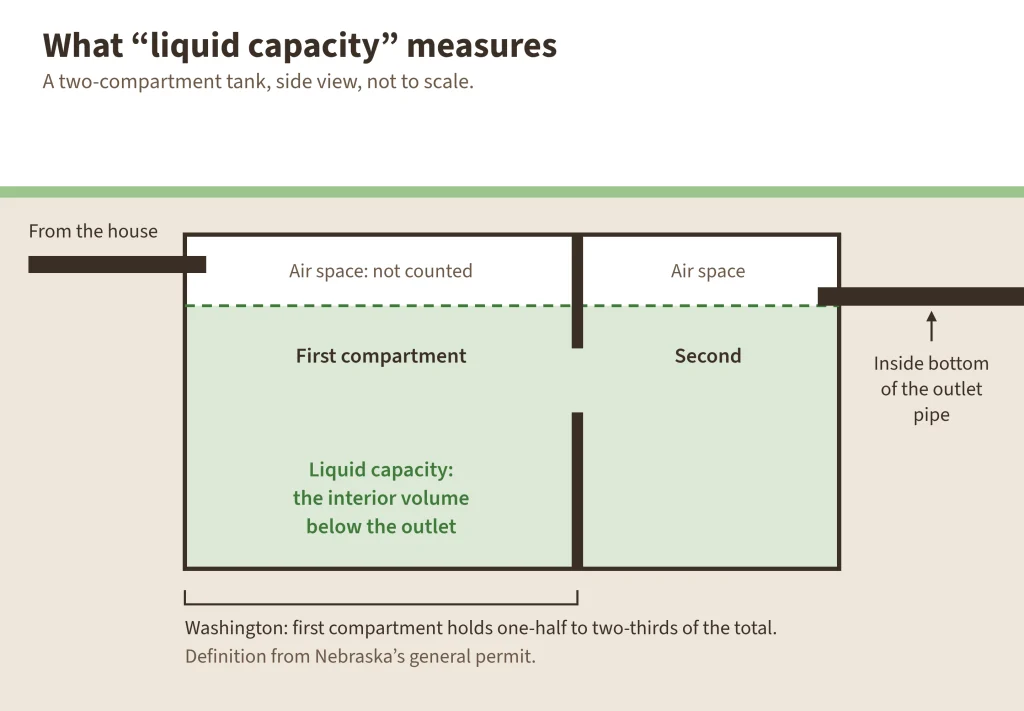
Every figure here is a liquid capacity: the working volume below the outlet, not the whole shell. Nebraska’s permit defines it as the interior volume below the inside bottom of the outlet pipe, not counting the air space above the water. Washington’s Table VII is headed “Required Minimum Liquid Volumes of Septic Tanks”. When you compare tanks, ask for the liquid or working capacity on the maker’s spec sheet. Our guide to the 1,000-gallon septic tank covers typical dimensions.
Compartments are a second requirement on top of size. Washington requires two, with the first holding half to two-thirds of the volume. Florida requires multiple chambers or tanks in series. Minnesota requires them when there’s a disposal or a pump. New York requires them with a garbage grinder and on any tank 10 feet or longer inside, with the first compartment holding 60 to 75% of the volume. Pennsylvania requires multiple compartments or tanks in series, with the first at least as large as the second but no more than twice its size.
Checking the tank you already have
If you’re buying a house or wondering whether your tank is undersized, start with paperwork, not a shovel. The county or local health department that permits septic systems may hold the original permit or an as-built drawing, and a pumping receipt or inspection report often notes the tank’s size. Our guide on how to find your septic tank walks through the records to ask for.
Don’t open a tank to measure it yourself. Washington’s Department of Health says to keep lids secured with bolts, screws or locks, never leave an open lid unattended, and teach children not to play on or open them. Gas is one reason. OSHA says hydrogen sulfide occurs naturally in sewers, is heavier than air and can collect in low-lying and enclosed spaces. It also warns that after a while, or quickly at high concentrations, you can no longer smell it.
Whether an older, smaller tank must be upgraded depends on your state and county. In Nebraska, for example, an existing system needs a new permit or general permit coverage when it fails, when it is replaced, altered or repaired (unless the repair is exempt), or when bedrooms are added (Title 124, Chapter 2, 004). Either way, a smaller tank fills faster, so expect to pump it more often.
What to ask your permitting office
- Which rule and table apply at this address, and does the county add anything to the state’s minimum?
- How do you count bedrooms? Do a den, office, finished basement or attic count?
- Does a garbage disposal, a grinder pump or a large tub change the size or the number of compartments?
- Is floor area part of the sizing here, as it is in Texas and Florida?
- Does the minimum change for an aerobic unit or another alternative system? (These seven figures are for conventional septic tanks.)
- For an existing system: does adding a bedroom or remodelling need a new permit or an inspection?
What this calculator can’t tell you
It covers seven states, single-family homes of one to six bedrooms, and conventional septic tanks only. It doesn’t size drain fields, pump tanks, aerobic units, holding tanks or commercial systems, and it doesn’t know your county’s additions. Rules change: Washington’s table changed in 2025 and Texas is rewriting its rules. Where a state isn’t listed, the range across the seven shows how far the answer can move. It isn’t your state’s rule. SepticPlain doesn’t design, install or pump septic systems, and we have no installer to recommend. A licensed designer, installer or your local permitting office makes the real decision.
This page is general information, not professional or legal advice.
Sources checked on 3 November 2026.
Formulas and sources
- Washington minimum: WAC 246-272A-0232 Table VII, effective 1 April 2025
- Minnesota table value: Minn. R. 7080.1930, Table V and subparts 2 to 4
- Minnesota minimum: Minn. R. 7080.1930, Table V and subparts 2 to 4
- New York minimum: NYS DOH 10 NYCRR Appendix 75-A.6, Table 3 (DOH copy, effective 2016)
- Pennsylvania design flow: 25 Pa. Code 73.31(a), septic tank capacity
- Pennsylvania minimum: 25 Pa. Code 73.31(a), septic tank capacity
- Texas usage rate by bedrooms: TCEQ RG-472, 30 TAC 285.91 Tables II and III (May 2017 compilation)
- Texas usage rate by living area: TCEQ RG-472, 30 TAC 285.91 Tables II and III (May 2017 compilation)
- Texas usage rate used: TCEQ RG-472, 30 TAC 285.91 Tables II and III (May 2017 compilation)
- Texas minimum: TCEQ RG-472, 30 TAC 285.91 Tables II and III (May 2017 compilation)
- Nebraska minimum: NDEE Title 124 booklet, general permit GTS220000, Tables 1 and 3 and H.3
- Florida flow by bedrooms: Fla. Admin. Code 62-6.008 Tables I and II (Cornell LII copy of the 2013 rule)
- Florida flow by building area: Fla. Admin. Code 62-6.008 Tables I and II (Cornell LII copy of the 2013 rule)
- Florida flow used: Fla. Admin. Code 62-6.008 Tables I and II (Cornell LII copy of the 2013 rule)
- Florida minimum: Fla. Admin. Code 62-6.008 Tables I and II (Cornell LII copy of the 2013 rule)
- Minimum under the rule picked: EPA: septic systems are regulated by states, tribes and local governments
- Smallest of the seven minimums: EPA: septic systems are regulated by states, tribes and local governments
- Largest of the seven minimums: EPA: septic systems are regulated by states, tribes and local governments
Sources
- WAC 246-272A-0232: septic tank volumes, Table VII (effective 1 April 2025)
- Minn. R. 7080.1930: septic tank capacity, Table V
- NYS DOH: 10 NYCRR Appendix 75-A, Table 3 (DOH copy, effective 2016)
- 25 Pa. Code § 73.31: septic tank capacity
- TCEQ RG-472: On-Site Sewage Facility rules compilation, 30 TAC 285.91 Tables II and III (May 2017)
- TCEQ: 2023 Chapter 285 rule proposal, project 2021-030-285-CE
- TCEQ: OSSF staff-initiated rulemaking project (last modified 20 March 2026)
- 30 TAC § 285.91 (Cornell LII copy; last amended effective 6 July 2023)
- NDEE: Title 124 booklet with general permit GTS220000 (version 02.2026)
- Fla. Admin. Code 62-6.008 (Cornell LII copy)
- Florida Administrative Code: rule 62-6.008 page (latest final version effective 16 July 2013)
- EPA: Frequent questions on septic systems (updated 11 March 2026)
- EPA: How to care for your septic system (updated 17 August 2026)
- Penn State Extension: Septic tank pumping (updated 21 July 2023)
- Washington DOH: Septic system lid safety
- OSHA: Hydrogen sulfide
- Angi: How much does a septic system cost? (updated 14 October 2026, sells leads to contractors)
- Angi: How much does septic tank pumping cost? (updated 14 October 2026, sells leads to contractors)