Most household septic tanks are pumped every three to five years, according to EPA. Penn State Extension recommends every two to three years. Neither is a rule. With the two published calculation methods below, a family of four on a 1,000-gallon tank comes out anywhere from about 15 months to about 2.6 years. The answer for your tank comes from measuring it: have the sludge and scum layers measured at every service visit, and pump when they reach the trigger. The calculator on this page does both kinds of math, from your household and from a measurement on a pumping report, and shows its working. More on keeping a system healthy is in our care and pumping hub.
Pumping intervals by tank size and household
Two published methods give very different charts. The first is a table printed by both Oregon State University Extension (EC 1343, revised March 2022, reviewed 2025) and Kansas State University Extension (MF-947, August 2010). It is for homes lived in all year, without a garbage disposal:
| Tank (gallons) | 1 person | 2 | 3 | 4 | 5 | 6 |
|---|---|---|---|---|---|---|
| 750 | 9.1 | 4.2 | 2.6 | 1.8 | 1.3 | 1.0 |
| 1,000 | 12.4 | 5.9 | 3.7 | 2.6 | 2.0 | 1.5 |
| 1,250 | 15.6 | 7.5 | 4.8 | 3.4 | 2.6 | 2.0 |
| 1,500 | 18.9 | 9.1 | 5.9 | 4.2 | 3.3 | 2.6 |
| 1,750 | 22.1 | 10.7 | 6.9 | 5.0 | 3.9 | 3.1 |
| 2,000 | 25.4 | 12.4 | 8.0 | 5.9 | 4.5 | 3.7 |
The second method is Penn State Extension’s arithmetic: about 60 gallons of solids per person per year, and pumping before sludge and scum fill about 30% of the tank. That gives years = tank gallons × 0.30 ÷ (60 × people). For the same grid:
| Tank (gallons) | 1 person | 2 | 3 | 4 | 5 | 6 |
|---|---|---|---|---|---|---|
| 750 | 3.8 | 1.9 | 1.3 | 0.9 | 0.8 | 0.6 |
| 1,000 | 5.0 | 2.5 | 1.7 | 1.3 | 1.0 | 0.8 |
| 1,250 | 6.3 | 3.1 | 2.1 | 1.6 | 1.3 | 1.0 |
| 1,500 | 7.5 | 3.8 | 2.5 | 1.9 | 1.5 | 1.3 |
| 1,750 | 8.8 | 4.4 | 2.9 | 2.2 | 1.8 | 1.5 |
| 2,000 | 10.0 | 5.0 | 3.3 | 2.5 | 2.0 | 1.7 |
The Penn State figures run about 40% to 60% of the extension table’s. The two make different assumptions about how full a tank may get, explained below. Read both as a range, not a schedule. If you don’t know your tank’s size, check the permit or a past pumping receipt. Our tank size calculator shows the state minimums a tank of your home’s age was likely built to.
We left out the extension table’s 2,500-gallon row. In Oregon’s version some of its figures break the pattern of the rest of the table: 5.0 years for five people but 4.8 for six, and 4.0 years for both seven and eight people. We couldn’t tell which figures are right.
How the calculator works
The calculator has two parts. The first estimates from your household, using Penn State’s method. Every assumption is an input you can change:
- Tank size. Liquid capacity in gallons, from your permit, as-built drawing or a pumping report.
- People. Everyone who lives in the home most of the year.
- Solids per person per year. 60 gallons by default, Penn State’s figure.
- How full the tank may get. 30% by default, Penn State’s limit. Set 25% to match EPA’s trigger.
- Time at home. 100% for a year-round home. A cabin used half the year might be 50%. Scaling solids by time at home is our own simple proportion, not a published method.
- Garbage disposal. Ticking it cuts the interval by one-third, as Kansas State Extension advises.
The second part uses a measurement. If a pumper or inspector has written down the tank’s liquid depth and the combined thickness of sludge and scum, enter those and the years since the last pump-out. The calculator works out how fast your tank is actually filling and how long until it reaches EPA’s 25% trigger. A measurement of your own tank beats any chart, including ours.
The formula and a worked example
The household estimate is three steps:
- Room for solids = tank gallons × how full it may get
- Solids per year = people × solids per person × share of the year at home
- Years between pump-outs = room ÷ solids per year, then × (1 − 1/3) if you use a garbage disposal
The calculator’s defaults are Penn State’s own example: a 1,000-gallon tank, four people, no disposal.
- Room for solids: 1,000 × 30% = 300 gallons
- Solids per year: 4 × 60 = 240 gallons
- Years: 300 ÷ 240 = 1.25 years, or 15 months
- With a garbage disposal: 1.25 × 2/3 = about 0.8 years, or 10 months
Penn State’s page puts this example at “about 1.5 years”. Its own figures give 1.25, so the page has rounded up. Its one-person example is exact: 300 ÷ 60 = 5 years, as the page says.
There’s a second wrinkle in the 60-gallon figure. Penn State starts from about 90 gallons of solid waste per adult per year, then assumes bacteria reduce it “by about 60%”. Taken literally, 90 gallons less 60% is 36 gallons, not 60. With 36 gallons, the four-person example becomes 300 ÷ 144 = 2.1 years. We keep 60 as the default because it’s the figure Penn State uses in its conclusion, and it errs toward pumping too early rather than too late. If you’d rather use the literal reading, change the input to 36.
Why the sources disagree
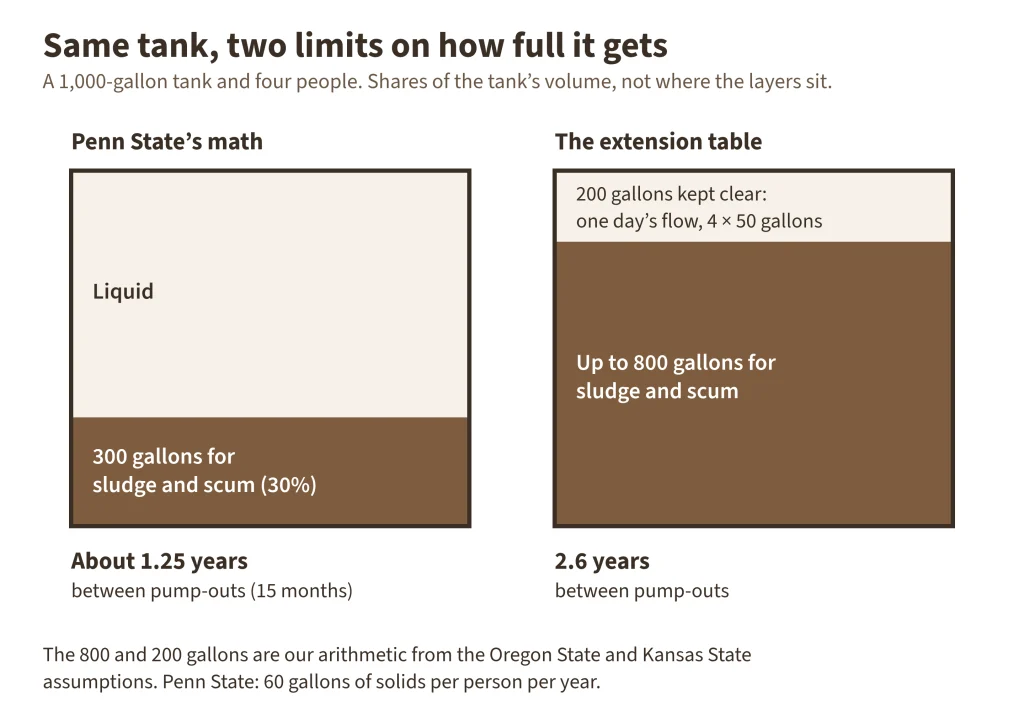
Most of the gap comes from one assumption: how much of the tank sludge and scum may fill before the tank stops doing its job.
- Penn State allows about 30% of the tank’s volume. It also says to pump when sludge is more than a third of the tank’s depth.
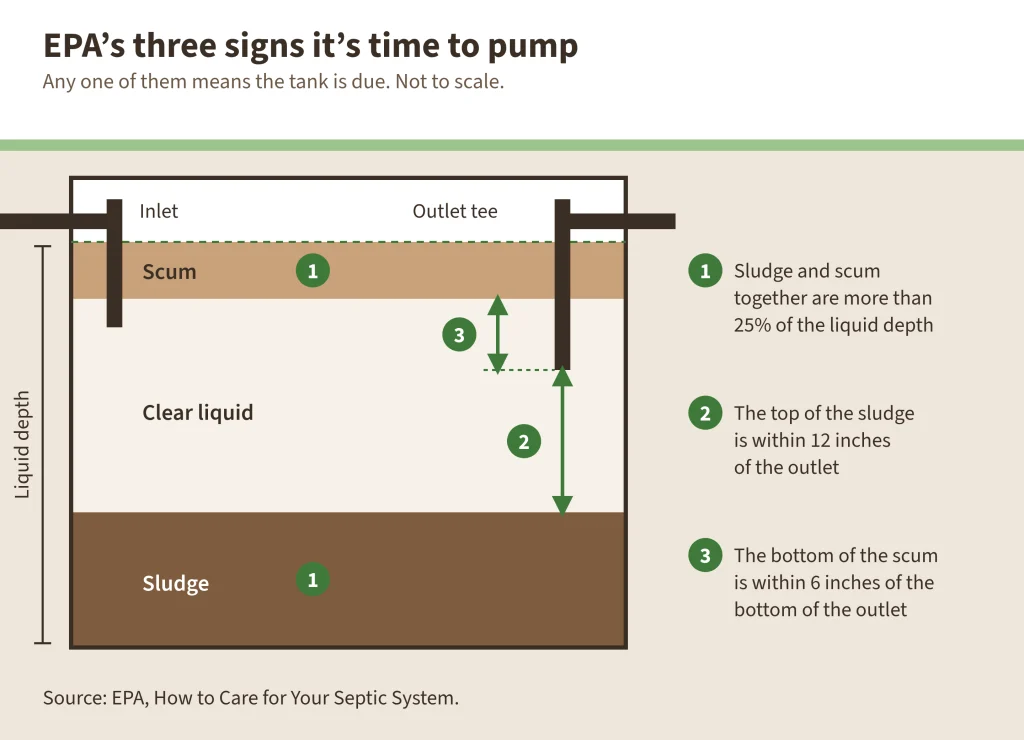
- EPA says to pump when sludge and scum are more than 25% of the liquid depth, when the top of the sludge is within 12 inches of the outlet, or when the bottom of the scum is within 6 inches of the bottom of the outlet.
- The extension table was worked out differently. Oregon and Kansas State say its figures keep at least 24 hours of wastewater in the tank and assume half the retained solids break down. Kansas State adds that they assume 50 gallons of wastewater per person per day. That leaves far more room for solids. For four people, one day’s flow is 200 gallons, so in a 1,000-gallon tank up to 800 gallons could go to sludge and scum before that limit is reached (our arithmetic).
The rate at which solids build up is similar in both methods. If you take the extension table’s room for solids as the tank size less one day’s flow, and divide by its years, you get about 75 to 79 gallons per person per year across the table, against Penn State’s 60. That’s our arithmetic, not a figure either extension publishes. So the table’s longer intervals come from letting the tank get much fuller, not from slower buildup. EPA’s 25% trigger is close to Penn State’s 30% limit, so Penn State’s math is the closer match to what EPA tells you to look for in the tank.
So why does EPA say three to five years when the math says sooner? EPA doesn’t give a calculation, so we can’t check it. Our reading, not EPA’s: real households differ from the formulas, because people are away at work and school, households are often smaller than four, and some tanks are bigger than the minimum. Kansas State also says flows above 50 gallons per person a day mean pumping more often. That’s why the published intervals are starting points and the measurement decides.
What state rules say
There is no national pumping rule. EPA says septic systems are regulated by states, tribes and local governments, not the federal government. Here are the four state rules we read on 3 November 2026:
| State | How often | When to pump | Source |
|---|---|---|---|
| Minnesota | The owner must check the tank (assess it for leaks and measure or remove the scum and sludge) at least every three years | Sludge and scum over 25% of the tank’s liquid capacity, the top of the sludge less than 12 inches from the bottom of the outlet baffle, or the bottom of the scum less than 3 inches above it | Minn. R. 7080.2450 |
| Massachusetts | “Typically necessary at least once every three years”; recommended every year with a garbage grinder | Sludge within 12 inches of the bottom of the outlet tee, or scum within 2 inches of the top or bottom of the tee | 310 CMR 15.351 (MassDEP’s copy of Title 5) |
| Virginia, Chesapeake Bay Preservation Areas | A pump-out at least once every five years, required through local programs; since 1 July 2023 the Virginia Department of Health enforces it in 12 Tidewater counties, including Accomack, Northampton and Gloucester | Localities may accept, instead of a pump-out, a plastic filter in the tank’s outflow pipe where the local health department agrees, or documentation every five years, certified by a licensed operator or onsite soil evaluator, that the system was inspected, works and doesn’t need pumping | 9VAC25-830-130 |
| Washington | Inspection at least every three years for a system that is only a septic tank and a gravity drain field; every year for all other systems; more often if the local health officer says so | No fixed interval: the owner must have an approved pumper empty the tank “when the level of solids and scum indicates that removal is necessary” | WAC 246-272A-0270 |
Only one of the four sets a fixed pump-out interval, and even Virginia’s five years comes with alternatives. Minnesota and Washington require regular checks, and Massachusetts requires pumping “whenever necessary”. Look up your own county’s rule before you rely on any interval, including this page’s.
Measure instead of guessing
EPA’s care page says to keep maintenance records and suggests writing down the sludge and scum levels each time a professional checks the tank. Do that, and after one or two visits you’ll know your own tank’s fill rate, which no chart can tell you. Ask the pumper or inspector to write down three numbers: the liquid depth, the sludge depth and the scum thickness.
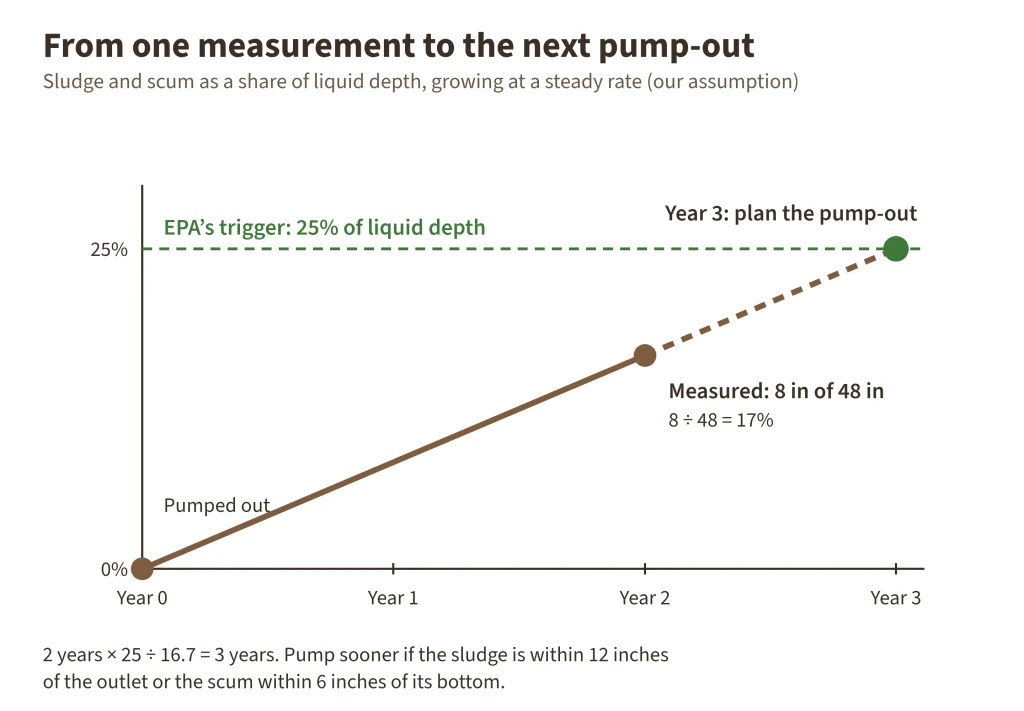
A worked example: two years after a pump-out, an inspector measures 48 inches of liquid with 8 inches of sludge and scum combined. That’s 8 ÷ 48 = 17% of the depth. At that pace the tank reaches 25% in 2 × 25 ÷ 16.7 = 3 years, so you’d plan the next pump-out about a year from now. This assumes the layers grow at a steady rate (our assumption), and it uses only EPA’s 25% trigger: pump sooner if the sludge is within 12 inches of the outlet or the scum within 6 inches of its bottom. Treat it as a planning estimate and have the tank checked again rather than stretching the date.
Leave the measuring to the professional. Extension guides describe homeowners measuring with a pole, but an open tank is dangerous. Penn State says to “never enter a septic tank for any reason”, because the gases inside can kill. If someone collapses in or near an open tank, call 911 and don’t go in after them. A 1986 NIOSH alert found that more than 60% of workers who died in confined spaces were would-be rescuers. Washington’s health department also gives lid safety advice: “Never leave an open lid unattended when inspecting or having your septic system pumped,” keep lids secured with bolts, screws or locks, and teach children not to play on them.
What changes your interval
- A garbage disposal. Kansas State says to cut the time between pumpings by about one-third. Massachusetts recommends pumping every year with a garbage grinder. Penn State only says grinders add solids. If you’re deciding whether to keep one, see our guide to garbage disposals and septic tanks.
- More people or more water. The interval falls with every added person. Kansas State says to pump more often if each person uses more than 50 gallons a day, and to adjust the schedule when the household changes.
- A bigger tank. At the same household size, room for solids grows with tank size. Kansas State advises installing a larger tank than the minimum where possible.
- Additives don’t stretch it. EPA’s septic FAQ says additives aren’t needed and “may decrease the performance of septic drainfields”. Penn State says additives are no substitute for pumping. Our septic tank treatment guide goes through what’s known.
- Systems with pumps or treatment units. EPA says alternative systems with float switches, pumps or mechanical parts should generally be inspected once a year. Washington requires yearly inspection of everything except a gravity tank and drain field. An aerobic unit’s pumping schedule is in its maker’s manual; see our aerobic septic system guide.

What a good pump-out includes
A pump-out should empty the whole tank and include a check. Based on Penn State’s and Kansas State’s guidance, the visit should include:
- Pumping through the large manhole, not the small inspection ports. Both extensions warn that pumping through the ports can damage the baffles, and Penn State adds that it can leave sludge behind.
- Emptying every compartment, every tank, and any separate pump chamber.
- Breaking up the scum and mixing in the sludge so the solids come out with the liquid.
- Checking the inside of the tank and the inlet and outlet baffles or tees. Kansas State says crusty or soft concrete, or roots inside the tank, are signs of deterioration or leaks.
- Cleaning and checking any effluent filter.
- A written record (our checklist; EPA says to keep maintenance records): date, gallons removed, the sludge and scum depths before pumping, and anything that needs repair. In Massachusetts the pumper records the condition on a state form and sends it to the local approving authority within 14 days (310 CMR 15.351). Elsewhere, ask for these details on the receipt.
Penn State suggests being there during the job and installing risers to the surface, which makes future service easier. For a full check of the system, beyond the tank, see our septic inspection guide.
What a pump-out costs varies by region and tank size. Clark County, Washington’s 2026 contract to pump its own tanks drew bids of $0.42 to $0.75 per gallon of tank size, or $420 to $750 for a 1,000-gallon tank before sales tax (bid tabulation). That’s a county route contract, not a single call-out for a homeowner. In published estimates, Angi gives a national average of $428, with most paying $292 to $565, based on 6,850 projects by its listed pros (updated 14 October 2026). Angi sells leads to contractors. Our septic tank pumping cost guide compares the sources and explains what can be added to the bill.
When not to wait for the schedule
Penn State says that by the time sewage backs up into the house, the drain field is already clogged, and pumping the tank won’t clear it. So don’t wait for the schedule if you see any of the failure signs EPA lists, among them sewage backing up into the home, very slow drains, gurgling plumbing, damp spots or sewage odors over the tank or drain field, or bright green, spongy grass there in dry weather. If sewage backs up into your home, EPA says to avoid contact with it and to contact your local health department for guidance. Sewage in the yard is also one for the health department. If you have a private well, EPA’s septic FAQ warns that untreated wastewater can contaminate drinking water wells; ask the health department about testing your water.
This page is general information, not professional or legal advice. Results from the calculator are estimates. Your local health department or permitting office decides what your system needs.
Sources checked on 3 November 2026.
Formulas and sources
- Room for sludge and scum before pumping: Penn State Extension: Septic Tank Pumping (Albert Jarrett, updated 21 July 2023)
- Solids added per year: Penn State Extension: Septic Tank Pumping (Albert Jarrett, updated 21 July 2023)
- Years between pump-outs without a disposal: Penn State Extension: Septic Tank Pumping (Albert Jarrett, updated 21 July 2023)
- Years between pump-outs: Kansas State University Extension MF-947: Septic Tank Maintenance (August 2010)
- Months between pump-outs: Penn State Extension: Septic Tank Pumping (Albert Jarrett, updated 21 July 2023)
- Measured share of liquid depth taken by sludge and scum: EPA: How to Care for Your Septic System (last updated 17 August 2026)
- Measured pace: years from pump-out to the 25% trigger: EPA: How to Care for Your Septic System (last updated 17 August 2026)
- Measured pace: years left before the 25% trigger: EPA: How to Care for Your Septic System (last updated 17 August 2026)
- Cut in time between pumpings with a garbage disposal (0.333333, as of 2010-08-01): Kansas State University Extension MF-947: Septic Tank Maintenance (August 2010)
- EPA pumping trigger: sludge and scum as a share of liquid depth (25, as of 2026-08-17): EPA: How to Care for Your Septic System (last updated 17 August 2026)
Sources
- EPA: How to Care for Your Septic System (last updated 17 August 2026)
- Penn State Extension: Septic Tank Pumping (Albert Jarrett, updated 21 July 2023)
- Oregon State University Extension EC 1343: Septic tank maintenance (revised March 2022, reviewed 2025)
- Kansas State University Extension MF-947: Septic Tank Maintenance (August 2010)
- EPA: Frequent Questions on Septic Systems (updated 11 March 2026)
- EPA: Resolving Septic System Malfunctions (updated 11 March 2026)
- Minnesota Rules 7080.2450: Maintenance
- 310 CMR 15.351: System pumping and routine maintenance (MassDEP copy of Title 5, file dated August 2023)
- 9VAC25-830-130: Chesapeake Bay Preservation Area general performance criteria (amended effective 25 September 2024)
- WAC 246-272A-0270: Operation and maintenance (effective 1 April 2025)
- Washington DOH: Septic System Lid Safety
- NIOSH Alert 86-110: Preventing Occupational Fatalities in Confined Spaces (January 1986)
- Clark County, Washington: Bid #2840 tabulation, septic tank pumping services (August 2026)
- Angi: How much does septic tank pumping cost? (updated 14 October 2026, sells leads to contractors)