
The quickest way to find a septic tank is usually a phone call: ask your county or local health department for the system’s permit and “as-built” drawing, a sketch made at installation that shows where the tank sits. If there’s no record, find where the sewer pipe leaves your house and work outward along its line. University of Georgia Extension says the tank is often 10 to 20 feet from the home, directly in front of the building sewer, with its top usually 1 to 4 feet down. Call 811 before you push a probe into the ground, and stop once you find the lid: don’t open it.
This page is part of our guides to how septic systems work and what you have. It covers the records to ask for, where tanks usually sit, how to probe without damaging the pipe, how to find the lids, and what a septic company charges to find the tank for you. SepticPlain doesn’t pump or install systems and doesn’t refer contractors.
The steps in order
- Ask for the records. The health department, the property file and the papers from when you bought the house. A drawing can save you all the digging.
- Look for anything already at the surface. EPA’s FAQ mentions an “access riser (black or green disc)”, and cleanout pipes may show where lines run.
- Find where the sewer leaves the house, in the basement or crawl space, and note the direction it heads.
- Call 811 to have public utility lines marked, knowing it won’t mark your own private lines.
- Probe gently along the sewer line until you hit a flat, hard surface. Then find all four edges of it.
- Find the lids over the ends of the tank and mark them. Uncovering and opening them is the pumper’s job.
- Measure and sketch the location so nobody has to search again. Then think about risers.
If any step goes wrong, such as wet ground that smells of sewage, a cracked lid, or a hole you can’t explain, stop and call the health department or a septic professional.
Start with the records
Septic systems are regulated by states, tribes and local governments, not the federal government, and permits are usually issued by a county or local health office. So the drawing of yours, if there is one, sits with the local permitting office. Washington’s health department says that if you can’t find the opening to your tank, you should contact your local health department, because it has likely issued permits that “may include a map of the septic tank location”. EPA says the same office can usually supply the record drawing and the permits, which may also list the installation date and soil properties.
How you get the record depends on the county. Four examples we read on 3 November 2026:
- Snohomish County, Washington, keeps as-built drawings and service history reports in an online database. The health department says an as-built “can show the location of a septic system, the year it was installed, the type of system”.
- Suwannee County, Florida, runs a free online search of scanned septic applications, permits, site evaluations and inspections, by address or tax parcel ID.
- Benton-Franklin Health District, Washington, provides as-builts on request by phone or in person. It asks for the owner’s name, the tax parcel number, the address (or nearby roads, if the address was once a rural route and box number), and how you want the copy delivered.
- Anne Arundel County, Maryland, keeps drawings for approved and inspected installations, and you can request a copy from its Department of Health by tax account number or street address. The copy is mailed to you if a record exists.
Have the parcel number ready. It’s on your property tax bill and the county’s parcel map, and it finds a file faster than an address that may have changed.
Older houses may have no file. Benton-Franklin notes that “Before 1975, permits were not required by law” in its area, so older systems may have no record. The year differs by county, but the point holds everywhere: the older the house, the less likely there’s a drawing. A file may also show only a repair or replacement, not the first system.
Other papers worth checking:
- The home inspection or septic inspection report from when you bought the house. A septic inspection normally means someone uncovered the tank, and EPA says an inspection includes reviewing “the system permit, design, and installation records”. See our guide to septic inspections for what a report should contain.
- Old pumping receipts. Some pumpers note where the tank is or how deep the lid was.
- The builder’s papers. University of Georgia Extension says the contractor who built the house “should have provided the first owner with a map of the tank and drainfield locations”.
- The deed, building permit and design plans, which EPA lists as places that may show whether a property has a septic system at all.
Reading an as-built. A typical drawing shows the house outline, the tank, the drain field and a few measurements. Treat them as approximate. A Washington field guide for homeowners defines the as-built as a county map with “the approximate location” of the system (Washington DOH and Clallam County field guide). Decks, additions and new driveways can also make old measurements hard to use. Use the drawing to decide where to start probing, not to dig a hole.
Where tanks usually sit
No national rule sets where a tank goes. States, tribes and local governments set the rules, and the figures differ. The table puts the public figures we found side by side.
| Source | Distance from the house | Depth to the top of the tank | What it is |
|---|---|---|---|
| University of Georgia Extension, Bulletin 1421, revised 18 Oct 2024 | “Often” 10 to 20 ft, directly in front of the building sewer; start probing about 6 ft out | “Usually” 1 to 4 ft | Homeowner guidance |
| Anne Arundel County Department of Health, Maryland | “Generally” 10 to 20 ft from the foundation | Not given for the tank; the sewer main is typically 1 inch to 3 ft down | Homeowner guidance |
| EPA FAQ, updated 11 Mar 2026 | Following the plumbing out of the house, the tank “is usually about 10 feet away from the building” | Not given | Homeowner guidance |
| Benton-Franklin Health District, Washington | Not given | Usually 12 to 18 in | Local guidance for systems with no record |
| Washington, WAC 246-272A-0210, effective 1 Apr 2025 | At least 5 ft from a building foundation | Not in this section | State rule, minimum setback |
| Minnesota, Minn. R. 7080.2150 and 7080.2000 | At least 10 ft from structures | No deeper than 4 ft for new dwellings, unless a local ordinance allows more | State rule, minimums and limits |
| Utah, R317-4-6, amended 29 Jun 2023 (read on Cornell LII) | Not in this section | 6 to 48 in of cover at final grading, with limited exceptions | State rule |
What this tells you on the ground:
- Don’t probe hard against the foundation. Setback rules keep newer tanks at least 5 to 10 feet out in the two states we read, and older systems may predate those rules. Georgia’s guide starts probing about 6 feet out.
- A shallow tank is easier to find than a deep one. Benton-Franklin’s 12 to 18 inches and Georgia’s 1 to 4 feet come from different places, so treat neither as a rule for your yard. Minnesota allows up to 4 feet for new homes, or more where a local ordinance permits it. Regrading, new topsoil or a raised lawn can add depth that was never on the drawing.
- The tank is bigger than you might think. Georgia’s guide says a tank is “typically 5 by 8 ft”. Benton-Franklin gives about 5 by 8 feet for a 1,000-gallon tank. You’re looking for a buried box, not a pipe.
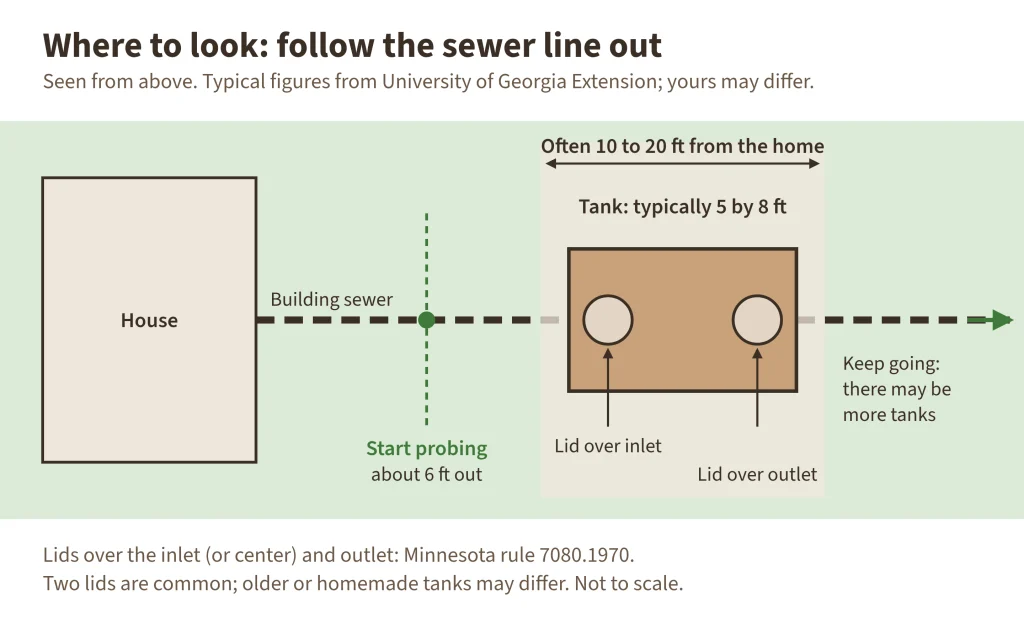
Find where the sewer leaves the house
In most houses the drains join into one building sewer pipe, which leaves through a basement or crawl space wall, or under the slab. Find it, note which wall it goes through and its angle, and you have the line the tank usually sits on. In its guidelines for locating your septic system, Anne Arundel County suggests finding where the main sewer line exits the house, then probing along it from outside.
- Indoors, look for the largest drain pipe, often with a cleanout cap near where it leaves the house.
- Outdoors, look for capped pipes sticking out of the lawn. Anne Arundel says these clean-out or marker pipes are usually cast iron or Schedule 40 PVC, 4 to 6 inches across, and may mark the tank, the distribution box, a drywell, the drain field or the sewer line. A pipe only tells you something is buried there, not which part.
- On a slab house, where the pipe goes down through the floor, an outdoor cleanout near the foundation is often the best clue to which side to start from.
Some homes have more than one tank, such as a septic tank followed by a pump tank, or a system with a tank, a pump chamber and a mound. Washington’s field guide shows a septic tank, a pump tank and a mound as separate parts with their own lids. If you find a tank, keep going in the same line: there may be more. Our guide to how a septic tank works shows the parts in order.
Clues in the yard
Walk the area in line with the sewer pipe before you probe. Things that can help:
- Risers and lids at the surface: round plastic or concrete covers, often green or black. Washington’s health department warns that “many systems are completely buried”, so finding nothing doesn’t mean there’s nothing there.
- A patch of lawn that looks different: many owners look for a rectangle of grass that browns first in a dry spell or where snow melts first, over a shallow tank. We found no public agency that vouches for this, so treat it as a hint for where to probe, not proof.
- A mound in the yard: EPA lists a mound over the drain field as a sign the property has a septic system. The tank is usually between the house and the mound.
- A low, sunken spot is worth avoiding rather than probing. It may only be settled soil, but you can’t tell from the surface whether there is a weak lid or a damaged tank underneath. Keep children and pets off it and have a professional look.
One clue is a warning, not a lead. Soggy ground, standing water or a sewage smell near the tank or drain field are signs of a failing system on EPA’s list. Don’t dig there. EPA says to avoid contact with sewage and to contact your local health department or regulatory agency. If you have a well, EPA’s FAQ also says to check with your local health department about having your water tested. Our drain field repair guide covers what happens next.
Probe without damaging anything
A probe is a thin steel rod pushed into the soil by hand. Georgia’s guide says rebar or a similar metal rod works.

Call 811 first. Georgia’s extension guide says to call 811 and have your utilities marked before probing, because “This free service can prevent you from driving a rod through your gas, water, telecommunications, or electricity line.” It adds that 811 “will only locate utility lines and not those ‘owned’ by the home/business”, such as irrigation lines and outdoor lighting runs. Your sewer pipe is one of those private lines too. Georgia’s guide says a hammer or mallet may be needed to tap the probe into firm soil; if you use one, tap lightly, and stop if the rod meets something that feels like a pipe.
How to probe, from Georgia’s guide:
- Start about 6 feet from the house, directly in line with the building sewer.
- Push the probe in gently. Both Georgia and Anne Arundel County warn about puncturing or damaging the sewer line, and a plastic pipe a foot down is easy to hit.
- Work outward along that line. When the probe stops on something hard, probe again about a foot further out, and keep going until it goes deeper. That’s the end of the tank.
- Find both ends this way and mark them with flags or stakes. Georgia’s guide stops at the ends; probing across the line the same way, still gently, gives you the sides. The guide says a tank is typically 5 by 8 feet, “but sizes can vary”.
- Expect false hits. Georgia warns that rocks, pipes and other debris can “feel” like the tank. One hard spot proves nothing. A flat surface at the same depth across several probes is what you’re looking for.
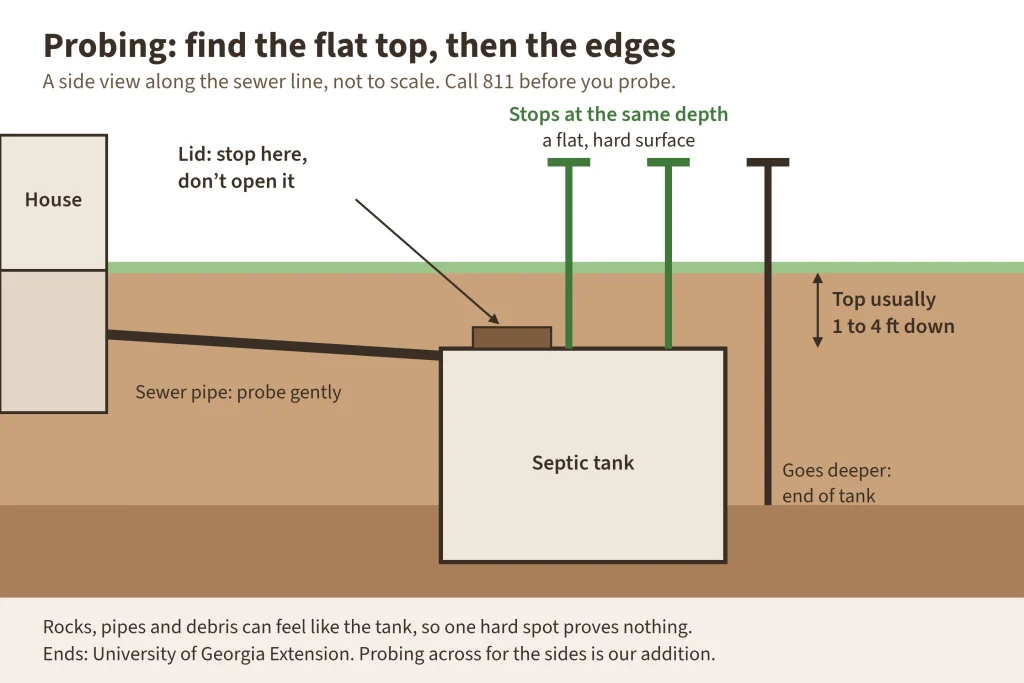
Two practical points from the same guide: probing is easier after rain, when the rod moves through wet soil more easily, and you shouldn’t drive or park over the tank or drain field. Georgia says doing so may damage or collapse the tank or drain lines, or compact the soil.
Metal detectors work on some tanks. Benton-Franklin Health District says a detector can help because concrete tanks contain rebar and lid handles are often metal wire. A plastic or fiberglass tank gives a detector much less to find, so a silent detector doesn’t rule out a tank.
Find the lids on the tank
Pumpers need the lids, not just the tank. Where the lids sit depends on when and where the tank was made:
- Two lids are common. Benton-Franklin says tanks installed after 1976 in its area have two compartments, and both need pumping. Their lids are round, about 20 to 24 inches across and often 5 to 5.5 feet apart. Washington’s statewide design rule requires at least two compartments, which can be one two-compartment tank or two single-compartment tanks in series, so a newer system may have two tanks.
- Over the inlet and the outlet. Minnesota’s tank rule, Minn. R. 7080.1970, requires septic tanks to have at least two maintenance holes, each at least 20 inches across, over the inlet baffle or tank center and over the outlet. So once you’ve marked the tank’s outline, look first near the end facing the house and the end facing away from it.
- On the tank or on a riser. Georgia says the lid is generally level with the top of the tank but can be on a riser. A riser is a pipe-like collar that brings the opening closer to the surface.
- Older or homemade tanks may not follow any of this. If the outline is clear but the lids aren’t, that’s a good point to hand over to a professional.
Mark where you think the lids are and leave the digging to the pumper. A lid may be 1 to 4 feet down, and it sits over the inlet or outlet, where the sewer pipe enters and the outlet pipe leaves the tank, so a spade can hit a pipe. Washington’s field guide warns that a lid “may be very heavy and require prying”. Lifting it is a job for the pumper.
Stop at the lid
Finding and marking the tank is a homeowner job. Opening it is not. Never open a tank to look inside, lean over an open one or reach in. Hydrogen sulfide from sewage is “heavier than air” and collects in low, enclosed spaces, OSHA says. At high levels you quickly stop being able to smell it, and OSHA’s hazard table lists “Nearly instant death” at 1,000 to 2,000 ppm. Wisconsin’s health department says methane and hydrogen sulfide are “both flammable and highly explosive”, so keep flames and cigarettes away from any opening. If someone collapses in or beside an open tank, call 911 and don’t go in after them. A 1986 NIOSH alert found that more than 60% of workers who died in confined spaces were would-be rescuers.
Washington’s health department also asks owners to know where their lids are, to keep lids secure with bolts, screws or locks, never to leave an open lid unattended during an inspection or pumping, and to teach children that lids aren’t for playing on or opening. It says to repair or replace damaged or missing parts. If your search turns up a cracked, loose or missing lid, don’t stand on it or lean over it, keep children and pets away, and call a septic professional or the health department.
Having someone find it
If there’s no record and probing gets you nowhere, Washington’s health department suggests a septic company, because “they have experience finding difficult-to-spot tanks”. Georgia’s guide says the local health department has a list of certified professionals who can help. Anne Arundel County recommends having a licensed professional locate the rest of the system, which it says can be done after a pump-out, and prepare a drawing of the whole system. Angi’s cost page prices locating by method, from a basic inspection up to a camera inspection. Not every pumper offers locating, so ask before you book.
What it costs. We found no government figure for locating alone. The first row is a published estimate, not a measured price:
| Source and date | Figure | What it measures |
|---|---|---|
| Angi, updated 29 Oct 2026 | $100 to $900 normal range; $400 average; $10 to $1,175 low to high | “Locating” a tank, from DIY to a camera inspection. Angi gives a basic inspection as $100 to $450 and a camera inspection as $250 to $1,175, so the range mixes locating with inspections. Angi sells leads to contractors and doesn’t state a sample size on this page |
| Clark County, Washington, bid 2840, opened 11 Aug 2026 | $0.42 to $0.75 per gallon of tank size to pump; $420 to $750 for a 1,000-gallon tank, before tax | A county’s annual contract to pump its own 44 tanks. Shown for scale: the sheet doesn’t say whether locating or uncovering lids is included |
It can make sense to have the tank found on the same visit as a pump-out, since the lids have to be uncovered for pumping anyway. Our septic pumping cost guide covers the rest of that bill. When you call, ask:
- Do you locate tanks, and is locating charged separately from pumping?
- Is digging to the lids included, and is it priced per lid or per foot of depth?
- Will you mark the tank and lids and give me measurements from the house?
- Will you pump every compartment, and check the baffles and any filter while the lids are open?
- Will the lids be secured before you leave?
Once you’ve found it
Make sure nobody has to search again. Georgia’s guide advises drawing “a rough sketch of its location relative to the house so it is not lost again!”
- Measure from two fixed points, such as two corners of the house, to the center of each lid. Two measurements fix a point. One doesn’t.
- Photograph the lid while the pumper has it uncovered, with a tape measure in the shot, before the soil goes back, so you have the depth on record.
- Keep the sketch with your pumping records. EPA advises keeping maintenance records and writing down the sludge and scum levels the professional finds.
- Think about risers. Washington’s field guide says risers “greatly add to the ease of locating and inspecting your system”. Minnesota’s rule requires maintenance-hole risers that extend above final grade, with covers secured by a lock, bolts or screws, a weight of at least 95 pounds, or another locally approved method, and labeled with a hazard warning. Utah requires watertight risers to within 6 inches of the surface where more than 6 inches of soil covers the tank. Those rules govern systems built under them, not every older tank. Ask your health department whether adding a riser needs a permit where you live. Our septic tank riser guide covers types and fitting.
- Keep the area clear. Washington’s health department and Georgia’s guide both say not to drive or park over the system. Don’t build a shed, patio or deck over the lids either, or the next pumper will have to search again.
- Plan the next pump-out. Now that you know the tank’s location, the pumping interval calculator estimates how often a tank of your size and household needs it.
If you can’t find a tank
Sometimes the answer is that there isn’t a standard tank. The house may be on a public sewer after all. EPA lists a “$0.00 charge for wastewater or sewer services” on the utility bill as one sign of septic, so a sewer charge points the other way. The property may have a cesspool instead of a septic tank, a holding tank, or an older system nobody recorded. Or the tank may be under a later addition, deck or driveway. In each case, the local permitting office is the place to ask, and EPA says it can point you to septic professionals who can locate the tank and drain field. Don’t build over, dig near or disturb an area you can’t account for until you know what’s under it.
Sources checked on 3 November 2026. Rules differ by state and county; your local permitting office decides what applies to your system. General information, not professional or legal advice.
Sources
- University of Georgia Extension: A Beginner's Guide to Septic Systems, Bulletin 1421 (minor revisions 18 October 2024)
- EPA: Frequent Questions on Septic Systems (updated 11 March 2026)
- EPA: Resolving Septic System Malfunctions (updated 11 March 2026)
- EPA: How to Care for Your Septic System (updated 17 August 2026)
- Washington State Department of Health: Septic System Lid Safety
- Washington DOH and Clallam County: Do-It-Yourself Septic System Inspection Field Guide (mound system)
- Snohomish County Health Department: As-Built Records
- Florida Department of Health in Suwannee County: Online Septic Search
- Benton-Franklin Health District: Sewage System Records
- Anne Arundel County Department of Health: Guidelines for Locating Your Septic System
- Washington WAC 246-272A-0210, horizontal separations (effective 1 April 2025)
- Washington WAC 246-272A-0232, septic tank compartments and volumes (effective 1 April 2025)
- Minnesota Rules 7080.2150, setback distances
- Minnesota Rules 7080.2000, sewage tank burial depth
- Minnesota Rules 7080.1970, sewage tank access
- Utah Admin. Code R317-4-6, design requirements (Cornell LII, amended 29 June 2023)
- OSHA: Hydrogen Sulfide
- OSHA: Hydrogen Sulfide hazards
- Wisconsin Department of Health Services: Sewer Gas (revised 18 April 2023)
- NIOSH Alert 86-110: Preventing Occupational Fatalities in Confined Spaces (January 1986)
- Angi: How Much Does It Cost to Locate a Septic Tank? (updated 29 October 2026, sells leads to contractors)
- Clark County, Washington: Bid 2840 tabulation, annual septic tank pumping (opened 11 August 2026)