
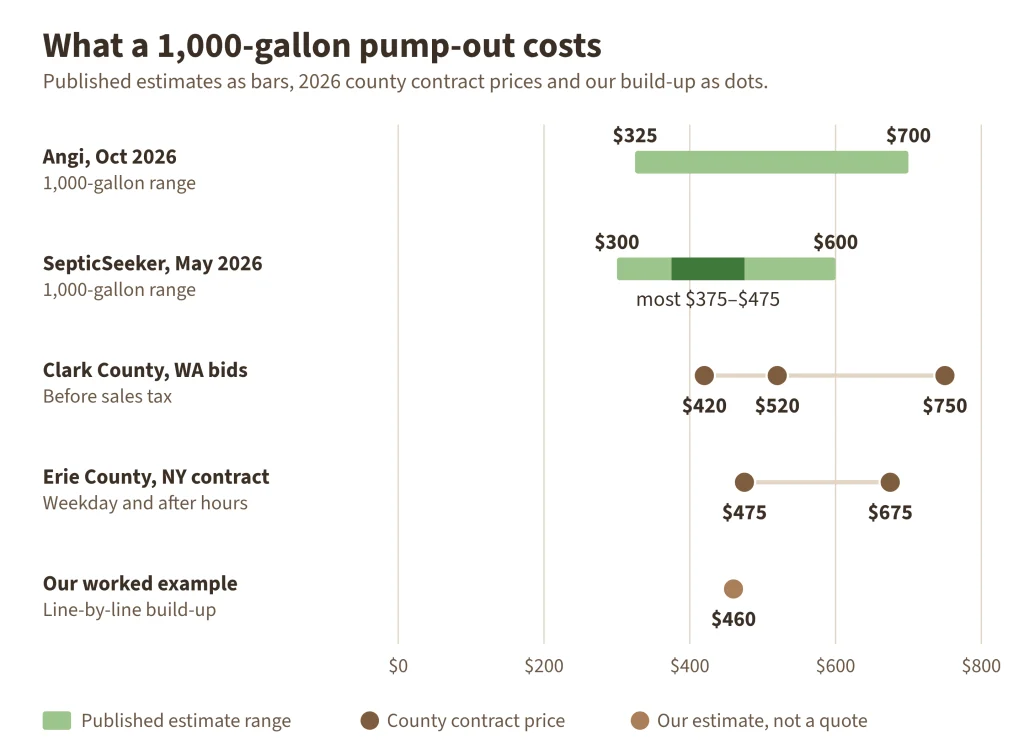
Pumping a household septic tank usually costs a few hundred dollars. Angi’s 2026 average is $428, and most of its customers paid $292 to $565. Two public pumping contracts from 2026 show similar prices for a 1,000-gallon tank: $420 to $750 in bids to Clark County, Washington, before sales tax, and $475 on a weekday under Erie County, New York’s contract. Our line-by-line build-up for the same tank comes to about $460. Much of the spread comes from what the pumper pays to dump the load, whether the lids are buried, and how far the truck drives. This page is part of our septic costs and tools section.
Below: the published estimates, what those contracts paid, the disposal fees plants charge haulers, what a proper pump-out includes and what to ask before you book. SepticPlain does not pump tanks, sell leads or recommend companies.
Published estimates side by side
No federal agency publishes a national price for septic pumping. The figures below are published estimates from commercial sites, several of which earn money by passing homeowners to contractors. Each is listed with its date and what it measures. We don’t average them.
| Source and date | Published estimate | What it measures |
|---|---|---|
| Angi, updated 14 October 2026 | Average $428; most pay $292 to $565; low $200, high $1,287 | “based on data from 6,850 verified projects by Angi Pros”. Angi says it surveyed thousands of its customers. Angi is a marketplace that connects homeowners with contractors |
| Angi, same page, by tank size | 750 gal $250 to $550; 1,000 gal $325 to $700; 1,250 gal $375 to $900; 1,500 gal $450 to $1,100; 1,750 gal $550 to $1,250 | Ranges by tank size. Method per row not stated |
| Angi, same page, by city | Minneapolis $175 to $275; Portland, Oregon $440 to $750 | Two of the city ranges Angi lists |
| HomeGuide, page dated 2 October 2023 (title says 2026) | $300 to $700; $0.30 to $0.70 a gallon; 1,500 gal $450 to $1,050; septic filter cleaning $100 to $400 | Pumping only. HomeGuide cites a “proprietary cost database” and gives no sample size. A lead-generation site |
| Homewyse, January 2026 | $0.41 to $0.48 a gallon; its line items total $205 to $241 for its default 500-gallon tank | A commercial estimator’s model of labor (with a 2-hour minimum) and supplies, not reported jobs. Excludes permits and sales tax on supplies. It doesn’t show what a 1,000-gallon tank would cost |
| SepticSeeker, updated 10 May 2026 | 1,000 gal $300 to $600, most $375 to $475; buried lids add $50 to $200; a never-pumped tank (10+ years) $700 to $1,500+ | A septic information site that also refers readers to local pros. It publishes no method: it says its confirmed rows cite Angi, HomeAdvisor, state agencies and extension services, and marks other rows “pending source verification” |
For a 1,000-gallon tank most of these cluster between about $300 and $700. Angi’s high of $1,287 and SepticSeeker’s “10+ years” line show what happens when a tank is badly overdue or hard to reach.
What two public contracts paid in 2026
Some counties that own buildings on septic systems put their pumping out to bid and publish the results. Those are prices local pumpers bid in writing, with the terms attached. They are not homeowner prices: a county buys many visits a year, which can bring the price per visit down. But they show how pumpers build a price.
| Contract | Pricing | A 1,000-gallon tank |
|---|---|---|
| Clark County, Washington, bid #2840, opened 11 August 2026. Annual pumping of 44 county tanks of 300 to 6,000 gallons at parks, maintenance sites, rental and caretaker houses | Three bids: $0.42, $0.51 to $0.52, and $0.75 per gallon of tank size | $420, $520 or $750, before Washington sales tax of 8.0% to 8.9%, which the county’s tabulation adds on top |
| Erie County, New York, bid 260121-002, opened 28 May 2026; prices good 1 June 2026 to 31 May 2028. Mostly county park tanks | $325 per service visit, plus $0.15 a gallon pumped during business hours (8am to 5pm) or $0.35 a gallon for emergency service on weekends and after hours. The visit fee is “per site and not per tank” | $475 on a weekday ($325 + 1,000 × $0.15); $675 on a weekend or after hours |
The same job priced by three local firms in one county ran from $420 to $750. The highest bid is nearly 80% above the lowest, which is a good argument for asking more than one pumper. The two counties also price differently. Clark County pays by the size of the tank; Erie County pays a trip fee plus the gallons actually pumped, and more than doubles the per-gallon rate outside business hours. Erie’s specifications also tell bidders that most cleanouts are above grade and marked, and that the farthest tank is about 150 feet from the road. Both conditions make a visit cheaper than one where the pumper has to dig.
Where the money goes: a worked example
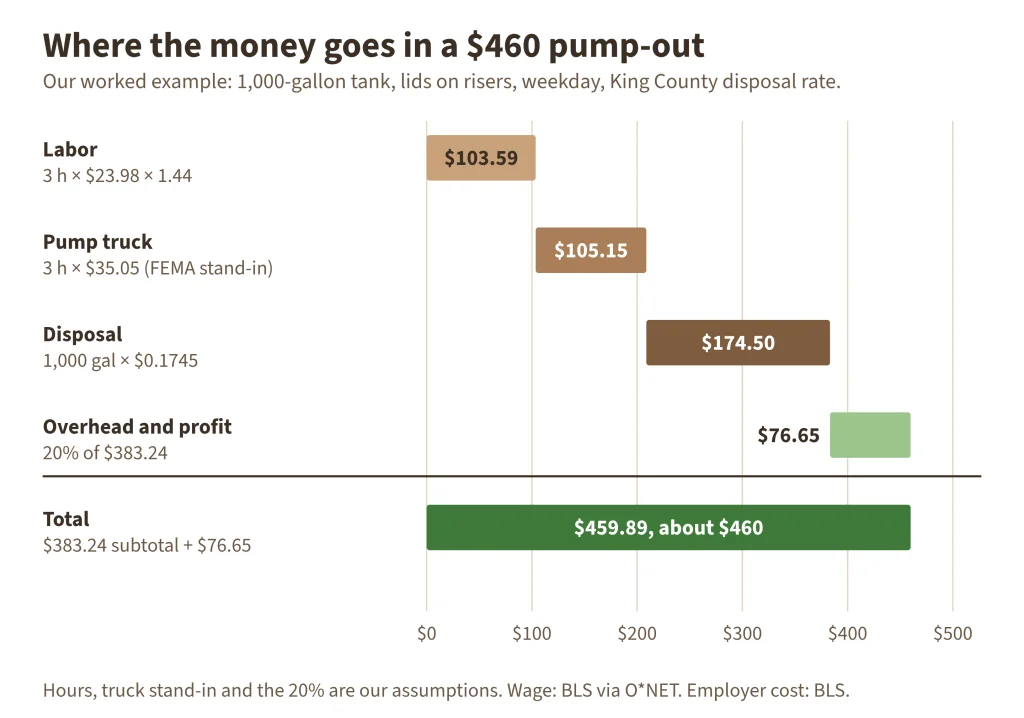
Here is a routine pump-out built up line by line, using our estimating method. The house: a 1,000-gallon single-compartment tank, lids already at the surface on risers, pumped on a weekday, with the load taken to a treatment plant that charges King County, Washington’s 2026 rate.
| Line | Working | Amount |
|---|---|---|
| Labor, one operator | 3 hours (our assumption) × $23.98 median wage × 1.44 employer cost | $103.59 |
| Pump truck | 3 hours × $35.05 an hour (FEMA’s 2025 rate for a 2,500-gallon water truck, our stand-in) | $105.15 |
| Disposal | 1,000 gallons × $0.1745 (King County, 2026) | $174.50 |
| Subtotal | $383.24 | |
| Overhead and profit | 20% (our assumption) | $76.65 |
| Total | $459.89, about $460 |
Where each line comes from:
- Hours, 3, our assumption. About an hour of driving to the house and back to base, an hour on site to open the lids, pump, check the tank and close up, and an hour to drive to the plant and unload. A pumper who can fit two homes into one truckload spreads that last hour across both, so this can run lower.
- Wage. Septic tank servicers and sewer pipe cleaners earned a median $23.98 an hour in 2025 (BLS data via O*NET OnLine, occupation 47-4071). That is wages only.
- Employer cost, 1.44. Construction employers paid $51.96 an hour in total compensation for every $36.13 in wages in June 2026 (BLS), so we multiply wages by 1.44 to cover benefits and payroll taxes. That survey has no separate figure for septic service firms, so construction is the nearest published ratio.
- Truck. FEMA’s Schedule of Equipment Rates sets the hourly rates it reimburses for equipment used in disasters declared on or after 1 July 2025. Its rates cover “ownership and operation of equipment, including depreciation, overhead, all maintenance, field repairs, fuel”, but not the operator. FEMA lists no septic pump truck. Its combined sewer-cleaning vacuum truck holds only 800 gallons of spoils, too small for this load, so we use its 2,500-gallon diesel water truck at $35.05 an hour (2025 schedule, cost code 8780) as a stand-in. That is our choice, not FEMA’s, and a real pump truck’s cost could be higher or lower.
- Disposal. King County’s 2026 septage rate is $0.1745 a gallon for domestic septic tank waste. It is the second-highest fee in the next section.
- Overhead and profit, 20%, our assumption. It follows the 10% overhead plus 10% profit convention in FEMA’s 2013 flood insurance Bulletin W-13064, written for general contractors. It has to pay for the office, dispatch, insurance, licenses and the hours a driver isn’t billing.
Change only the disposal fee and the same visit moves a long way. At Cedarburg, Wisconsin’s 2026 rate ($51 per 1,000 gallons plus $10 a load) the total is about $324. At $0.35 a gallon, the rate Athens-Clarke County, Georgia charges for septage from outside the county, it is about $670. Each extra hour on site, for example to dig down to buried lids, adds about $83.50 in this build-up: $34.53 of labor and $35.05 of truck, plus 20%.
Our $460 sits inside Angi’s typical range and close to the two county contracts. That doesn’t make it what you will pay; it shows roughly what a typical bill is made of.
Disposal fees: the part with a public price
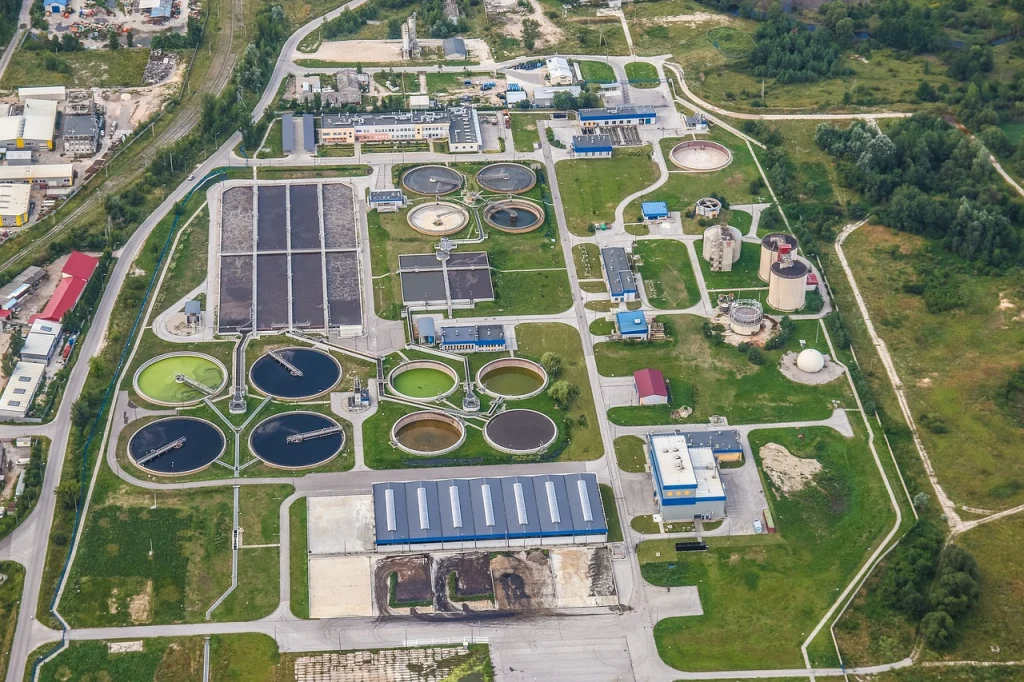
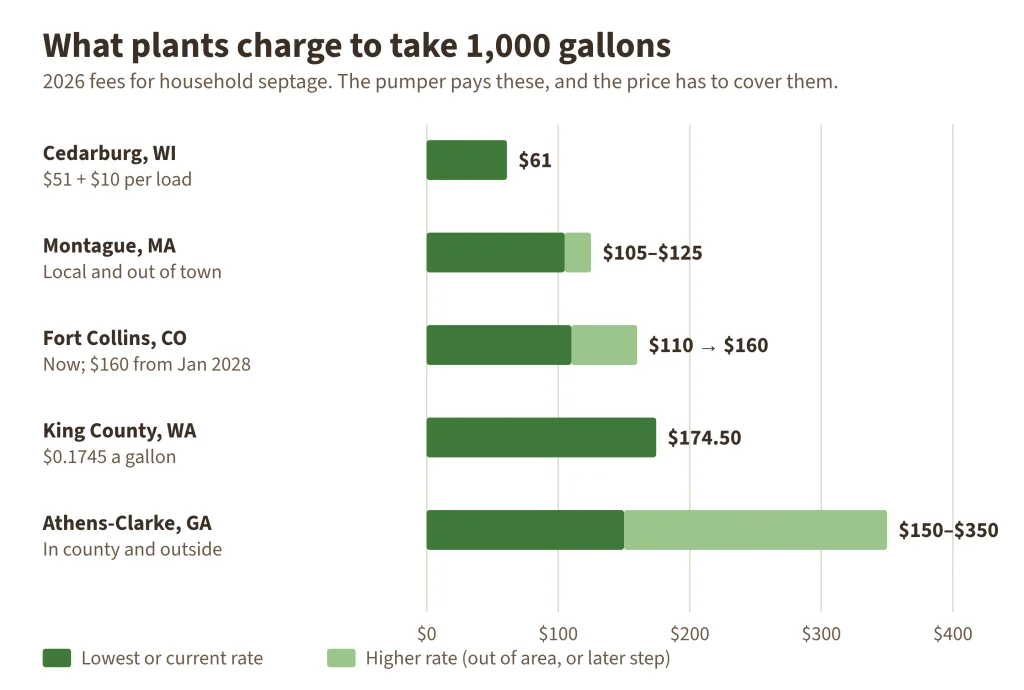
Everything a pumper takes out of your tank has to go somewhere, usually a municipal treatment plant that charges haulers by the gallon. These are public fee schedules. They are what the pumper pays, not what you pay, but the pumper’s price has to cover them.
| Plant | Fee for household septage | Per 1,000 gallons |
|---|---|---|
| Cedarburg, Wisconsin, effective 1 January 2026 | $51.00 per 1,000 gallons, plus a $10 administrative fee per truckload | $61 for one load |
| Fort Collins, Colorado, city council agenda, 5 May 2026 | $0.09 a gallon until July 2026. An ordinance adopted on 5 May 2026 raised it to $0.11 on 1 July 2026, then $0.13 in January 2027 and $0.16 in January 2028. Staff say a state grant could change the 2028 step | $110 now, rising to $160 |
| Montague, Massachusetts, fiscal year 2027 rates (from 1 July 2026), unchanged from 2026 | $105 per 1,000 gallons from Montague and Gill; $125 from out of town | $105 to $125 |
| Athens-Clarke County, Georgia, calendar 2026 | $0.15 a gallon for septage from inside the county; $0.35 from five named neighboring counties or farther away, accepted only when an Athens-Clarke-based hauler delivers it. The 2027 rates are $0.17 and $0.38 | $150 to $350 |
| King County, Washington, calendar 2026 | $0.1745 a gallon, which includes a $0.01 surcharge for failing on-site system programs; plus $200 per truck per year | $174.50 |
For the same 1,000 gallons that runs from $61 at Cedarburg to $350 at Athens-Clarke’s outside-county rate, nearly six times as much, and fees are rising in places. Fort Collins staff wrote that the old fee didn’t cover the plant’s operating costs and that “fee increases for haulers are likely to be passed down to septage customers, many of whom reside in rural communities”. If a pumper’s quote seems high, ask where they take the load and what that plant charges; the fee schedules are public.
What raises the bill
- Tank size. Bigger tanks mean more gallons to haul and dispose of. In Angi’s table a 1,500-gallon tank costs about $125 to $400 more than a 1,000-gallon one. The system’s permit or as-built drawing, if the health department has one on file, may give the size.
- Buried lids. If nobody knows where the tank is, or the lids are a foot or more down, someone has to find them and dig. SepticSeeker puts that at $50 to $200 a visit. Our guide on how to find your septic tank and its lid covers the records to check first, and septic tank risers bring the lids up to the surface so the next visit costs less.
- How overdue it is. A tank that hasn’t been pumped in many years can hold hardened sludge that takes longer to break up and remove. SepticSeeker’s $700 to $1,500+ for a never-pumped tank is its estimate for that case.
- Distance and hose length. Rural trips take longer, and a tank far from the driveway needs more hose. Erie County told its bidders the farthest tank was about 150 feet from the road.
- Time of day. Erie County’s contract more than doubles the per-gallon rate on weekends and after hours. A backup on a Sunday costs more than a booking on a Tuesday. Angi notes that frozen ground also makes winter access harder in cold climates.
- More than one compartment or tank. Two-compartment tanks, a second tank or a separate pump tank mean more to pump. Ask whether the price covers all of them.
- Extras on the same visit. Cleaning a septic filter ($100 to $400 in HomeGuide’s estimate), replacing a broken baffle, or a camera inspection of the line are separate jobs that may be added to the bill.
- Sales tax. Some states tax the service. Clark County’s bid tab, for example, adds Washington sales tax to every price.
What a proper pump-out includes
A pump-out is more than emptying the tank: done well, it is also a quick look at the system’s health. A University of Rhode Island Cooperative Extension fact sheet, hosted in EPA’s nonpoint source toolbox, gives homeowners a checklist for what the pumper should do. In short:
- Before pumping: note the liquid level against the outlet pipe. Below the outlet usually points to a leaking tank; above it can point to a problem in the pipe to the drain field or the field itself.
- Pump through the manhole, not the small inspection ports, which can damage the tees and baffles. If the ports must be used, pump through both, so every part of the tank is emptied.
- Watch for backflow from the outlet pipe. A lot of it suggests the drain field is backing up.
- Pump thoroughly, loosening sludge in the corners, and don’t leave septage behind to “seed” the tank. The fact sheet also says not to scrub or power-wash the walls.
- After pumping: check the empty tank for damaged baffles, cracks, leaking seams or an open weep hole.
- File the report if your town requires one. The fact sheet tells homeowners to ask the town whether they or the pumper file it.
EPA says that when you call a septic service provider, they will “inspect for leaks and examine the scum and sludge layers”, and that the provider “should note repairs completed and the tank condition in your system’s service report” (EPA, How to Care for Your Septic System, updated 17 August 2026). EPA also tells owners to write down the sludge and scum levels the professional finds, so you can judge when to pump next.
Questions to ask before you book
- Is the price per gallon of tank size, per gallon pumped, or a flat fee? The two counties above use different methods. With a per-gallon-pumped price, check the gallons on the report against your tank size: a tank that wasn’t fully emptied costs less but leaves solids behind.
- Is disposal included? If not, which plant, and at what rate?
- Is finding and uncovering the lids included? If the lids are buried, ask for the digging charge up front.
- Does the price cover every compartment and every tank, including a pump tank if you have one?
- Is there a trip charge, or an after-hours or weekend rate?
- Will I get a written report with the date, gallons removed, sludge and scum levels, liquid level on arrival, and the condition of the baffles and any filter?
- Is the company licensed or registered where you live? Septic systems are regulated by states, tribes and local governments, not the federal government (EPA’s FAQ), so ask your local health department whether pumpers need a license there.
Red flags
- An additive sold as a substitute for pumping. EPA says additives are “not recommended for domestic wastewater treatment”, warns they “may decrease the performance of septic drainfields”, and does not recommend products (EPA FAQ, updated 11 March 2026). The Rhode Island fact sheet says research shows biological additives don’t improve system function, and that skipping pump-outs can let solids clog the drain field. Our page on septic tank treatments and additives covers the evidence.
- Pumping only through a small inspection port without explaining why.
- No report, or a report with no sludge, scum or liquid-level notes. You lose the record that tells you when to pump next.
- A high liquid level or heavy backflow that nobody mentions. Both can point to a drain field problem. Pumping the tank won’t fix that. Our guide to drain field repair explains the signs and options.
- Pressure to buy a big repair on the spot. EPA says to hire a repair person soon if repairs are recommended. It does not say to hire whoever is there. For a large job, get the finding in writing and a second opinion.
How often, and what it costs per year
EPA says household tanks “are typically pumped every three to five years” and that the average system should be inspected at least every three years (EPA, How to Care for Your Septic System). Penn State Extension’s septic tank pumping guide (updated 21 July 2023) says every two to three years. Neither is a legal rule. The right interval depends on household size, water use and tank size, and EPA’s FAQ says a garbage disposal means pumping more often.
At Angi’s $428 average, pumping every three years works out to about $143 a year, and every five years about $86 a year. Our septic pumping interval calculator works out an interval for your household and tank, with the math shown.
Some places set their own schedule. Washington’s state rule, for example, requires the system to be inspected at least every three years when it is only a tank and gravity drain field, and every year for other systems, unless the local health officer sets more frequent inspections (WAC 246-272A-0270). Check with your local health department.
Pumping isn’t an inspection
A pumper’s look into an empty tank is useful, but it is not a full system inspection. EPA’s list of what an inspection involves also covers the permit and pumping records, the distribution box, pumps, controls and wiring, and the drain field (EPA, Resolving Septic System Malfunctions). HomeGuide’s published estimate (page dated 7 December 2023) is $150 to $450 for a routine inspection and $300 to $650 for one at a home sale, with pumping usually extra. Our septic inspection guide explains what it covers and the states that require one at sale.
Systems with pumps or treatment units need more attention. EPA says alternative systems with “electrical float switches, pumps, or mechanical components should be inspected more often”, generally once a year, and that a service contract is important because they have mechanical parts. If you have an aerobic unit, ask whether pumping is included in the contract and how often it’s needed. We found no published pumping price specific to aerobic systems.
Safety while the tank is open
An open septic tank is dangerous. “People do accidently fall into septic tanks,” Washington’s Department of Health warns, and it tells owners: “Never leave an open lid unattended when inspecting or having your septic system pumped”. It also advises securing lids with bolts, screws or locks, and teaching children not to play on or open them (Washington DOH, Septic System Lid Safety).
Septic tanks also hold gases. OSHA says hydrogen sulfide is “heavier than air”, can build up in low-lying areas and confined spaces, and that after a while, or quickly at high levels, “you can no longer smell it” (OSHA, Hydrogen Sulfide). Keep children and pets back while the lid is off, and never lean into or enter a tank. If anyone collapses in or near an open tank, call 911 and don’t go in after them: a 1986 NIOSH alert, which lists septic tanks among confined spaces, says more than 60% of deaths in confined spaces are among would-be rescuers.
If sewage backs up into the house, EPA advises avoiding contact with it and contacting your local health department or regulatory agency for guidance (EPA, Resolving Septic System Malfunctions). Call the health department too if sewage or wet, smelly ground shows up over the tank or drain field, which EPA lists among the signs of a failing system. A failing system can contaminate drinking water wells, and EPA’s FAQ says to check with the health department about having your water tested.
This page is general information, not professional or legal advice. Prices are published estimates and our own worked example, not a quote or a fair price for your job. Your local health department or permitting office sets the rules where you live.
Sources checked on 3 November 2026.
Sources
- Angi: How Much Does It Cost to Pump a Septic Tank? (updated 14 October 2026, sells leads to contractors)
- HomeGuide: Septic tank pumping cost (page dated 2 October 2023, lead-generation site)
- Homewyse: Cost to clean septic tank (January 2026, commercial estimator)
- SepticSeeker: Septic tank pumping cost (updated 10 May 2026)
- Clark County, Washington: ITB #2840 Annual Septic Tank Pumping Services, bid tabulation (opened 11 August 2026)
- Erie County, New York: Bid 260121-002 Septic Tank Pumping, award memo and pricing (1 June 2026 to 31 May 2028)
- King County, Washington: Septage disposal costs, 2026
- City of Cedarburg, Wisconsin: Wastewater hauler charges (effective 1 January 2026)
- City of Fort Collins: Council agenda item summary, second reading of Ordinance No. 044, 2026, septage receiving fees (5 May 2026)
- City of Fort Collins: City Council action agenda, 5 May 2026 (Ordinance No. 044, 2026 adopted on second reading)
- Town of Montague, Massachusetts: Sewer usage rates, FY2027
- Athens-Clarke County, Georgia: Sewer, wastewater and septage rates
- O*NET OnLine: Septic Tank Servicers and Sewer Pipe Cleaners, 47-4071.00 (BLS 2025 wage data)
- BLS Employer Costs for Employee Compensation, June 2026, Table 4
- FEMA: Schedule of Equipment Rates
- FEMA 2025 Schedule of Equipment Rates (copy hosted by Alabama ADECA)
- FEMA NFIP Bulletin W-13064: Allowance for Overhead and Profit (8 October 2013)
- University of Rhode Island Cooperative Extension: What to expect during a septic tank pump-out (EPA nonpoint source toolbox)
- EPA: How to Care for Your Septic System (updated 17 August 2026)
- EPA: Frequent Questions on Septic Systems (updated 11 March 2026)
- EPA: Resolving Septic System Malfunctions (updated 11 March 2026)
- Penn State Extension: Septic Tank Pumping (updated 21 July 2023)
- Washington State Legislature: WAC 246-272A-0270
- HomeGuide: Septic tank inspection cost (page dated 7 December 2023)
- Washington State Department of Health: Septic System Lid Safety
- OSHA: Hydrogen Sulfide
- NIOSH Alert 86-110: Preventing Occupational Fatalities in Confined Spaces (January 1986)