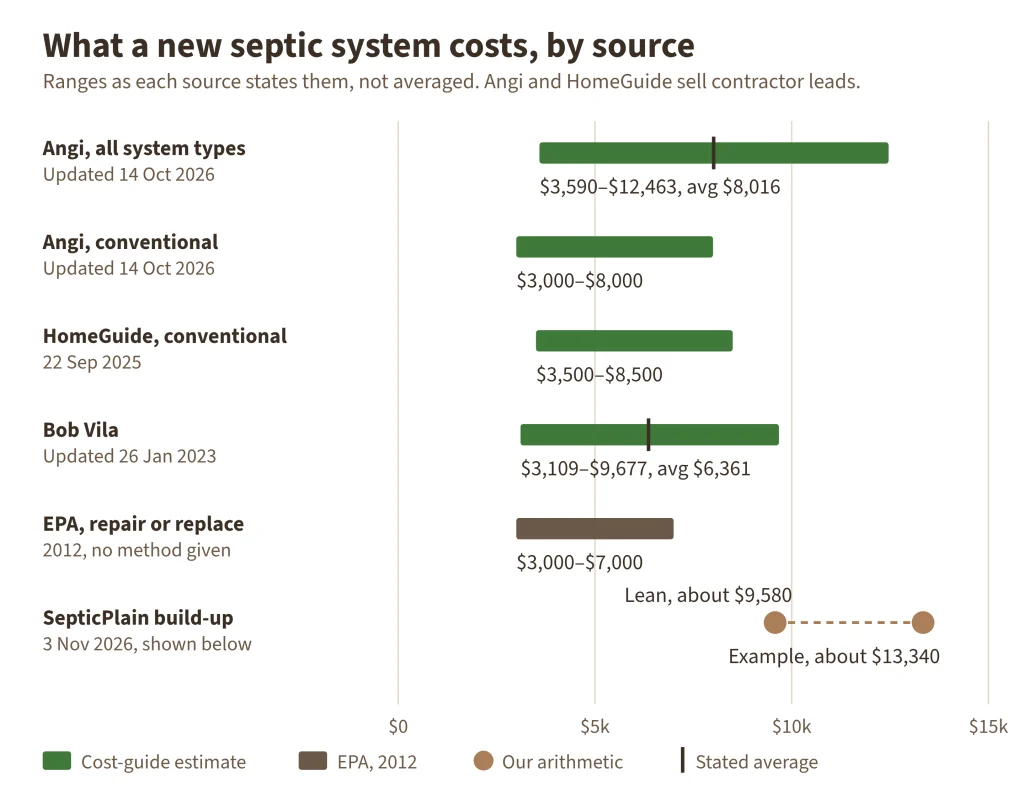
Putting in a new septic system usually costs $3,590 to $12,463, according to Angi’s estimate (updated 14 October 2026). That range covers all system types, and Angi gives an average of $8,016. For a conventional gravity system alone, HomeGuide gives $3,500 to $8,500. Our own build-up, from dated retail prices, BLS wages and FEMA’s excavator rate, comes out higher. For a 3-bedroom house with a 1,000-gallon-class tank and a 750 sq ft drain field, it’s about $13,340, which includes $2,045 for the permit, soil test and design. A leaner version of the same job comes to about $9,580. The calculator on this page runs the same arithmetic for your system, and you can change every price and hour. For pumping, replacement and other septic costs, see our septic costs and calculators.
This page covers a conventional system: a tank, then gravity flow to gravel trenches. If the soil test rules that out, you’ll need a different design, and the price is in another range. Mound and aerobic systems have their own section below, and our guide to the types of septic systems explains when each one is used.
Published estimates side by side
No federal agency publishes current installed septic prices. EPA says septic systems are regulated by states, tribes and local governments, and we found no state that publishes an average installed price for conventional systems. So the figures below come from commercial cost guides, most of which also sell contractor leads. They are published estimates, not measured prices, and we haven’t averaged them.
| Source and date | New system | What it measures |
|---|---|---|
| Angi, updated 14 Oct 2026 | $3,590 to $12,463 for most; $8,016 average; $500 low, $25,000 high | “1,277 verified projects,” all system types. Conventional (anaerobic) systems $3,000 to $8,000. Says labor is 50% to 70% of the total |
| HomeGuide, 22 Sep 2025 (title says 2026) | $3,500 to $8,500 for conventional; $4,000 to $15,000 alternative; $15,000 to $50,000 engineered | “Proprietary cost database” and industry input, no sample size. Gives excavator and operator time at $100 to $300 an hour |
| Bob Vila, updated 26 Jan 2023 | $3,109 to $9,677; $6,361 average | Lists HomeAdvisor and HomeGuide as sources. Nearly four years old |
| EPA SepticSmart homeowner guide, 2012 | $3,000 to $7,000 | Cost of repairing or replacing a malfunctioning system, not a new one. No method given. Fourteen years old |
| SepticPlain build-up, 3 Nov 2026 | About $13,340 for our example; about $9,580 lean | Retail prices, BLS wages and FEMA’s equipment rate, with hours and margin as our assumptions. Shown in full below |
Angi’s range rests on reported jobs, but those jobs mix every system type. HomeGuide’s conventional range is narrower, but HomeGuide doesn’t say how many jobs or what years it’s based on. Bob Vila’s page draws on HomeAdvisor, which shares Angi’s data, and on HomeGuide. None of the pages we read gives the drain field size behind its figures.
Our worked estimate for a 3-bedroom house
The example is a 3-bedroom house on a lot with ordinary soil and nothing unusual in the way. Every figure below is a default in the calculator. Prices are retail list prices seen on 3 November 2026. Installers often buy for less, and prices change. Our method page explains how these build-ups work.
The sizes it assumes
- Tank: about 1,000 gallons. That’s the 3-bedroom minimum in Washington, Minnesota, New York and Nebraska, with more required for a garbage disposal or grinder in Minnesota, New York and Nebraska. Pennsylvania sets 900 gallons. Florida’s table, which we read on a reproduction of the rule, gives 900 for a 3-bedroom home of 1,201 to 2,250 sq ft. Texas sets 1,000 for 3 bedrooms under 2,500 sq ft, or 750 with water-saving fixtures, according to TCEQ’s published Table II. Our tank size calculator shows the rule for each of these states.
- Drain field: 750 sq ft of trench bottom. Nebraska’s table for dwellings gives that figure for a 3-bedroom home (400 gallons a day) on soil that percolates at 20 to 30 minutes per inch. On slower soil the same house needs up to 1,050 sq ft. Other states use other tables, and your soil test and design set the real figure.
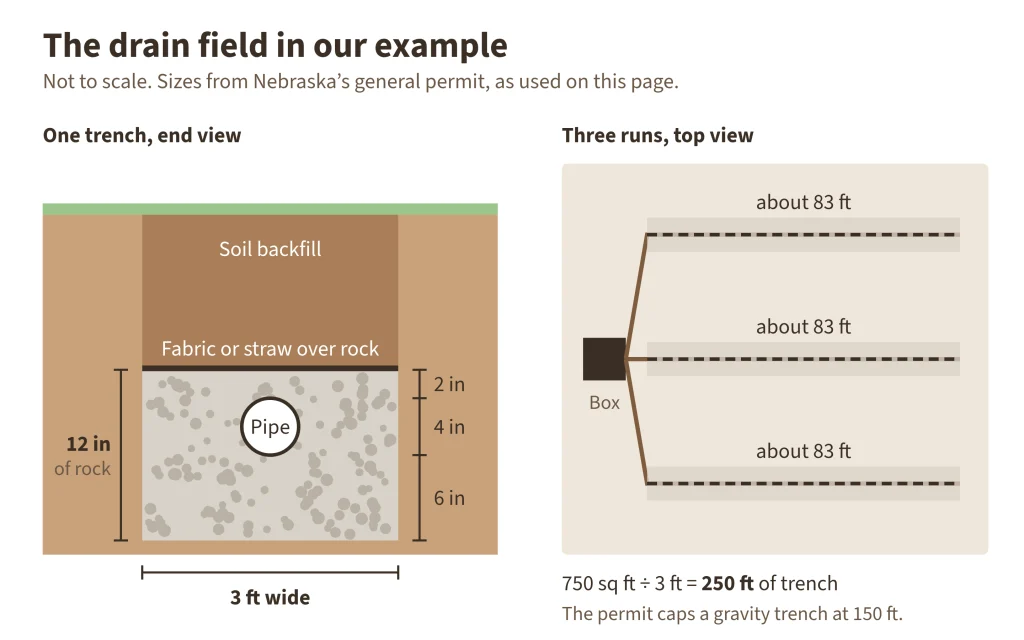
- Trenches: 3 ft wide, with 12 inches of rock. Nebraska’s general permit allows pipe trenches 18 to 36 inches wide, with at least 6 inches of rock under the pipe and 2 inches over it. With a 4-inch pipe, that’s 12 inches. So 750 sq ft is 250 ft of trench. The permit caps a gravity trench at 150 ft, so our example uses three runs of about 83 ft.
Materials
- Tank: a 1,060-gallon plastic tank, listed at $1,599 by Septic Solutions, pickup only. Concrete tanks are sold by local precasters. One Pennsylvania precaster listed a 1,000-gallon two-compartment tank at $1,500 for pickup in a November 2025 sponsored post, with delivery extra.
- Effluent filter: a 4-inch gravity outlet filter, $90.
- Risers: two 24-inch riser packages with lids, 20 inches tall, $335 each = $670.
- Distribution box: a 4-hole box with cover, $72.50.
- Perforated pipe: 250 ft, or 25 lengths of 4-inch ASTM D2729 pipe at $14.93 per 10 ft = $373.25.
- Solid pipe: 70 ft (our assumption: 25 ft from the house to the tank, 15 ft to the box, and 30 ft of headers), or seven 10 ft lengths of 4-inch SDR 35 at $22.43 = $157.01.
- Drain rock: 750 sq ft × 1 ft = 750 cu ft, or 27.78 cubic yards. At 1.4 tons a cubic yard (our assumption), that’s 38.89 tons. At $40 a ton delivered (also our assumption), it comes to $1,555.56. For comparison, USGS estimates the average value of crushed stone, across all uses, at $18.50 a metric ton in 2025. Defiance County, Ohio’s 2026 bids for #57 crushed stone ran $20.50 to $26.00 a ton, and the tab doesn’t say whether delivery is included. Our $40 allows for a small order delivered to one house costing more than a county’s bulk purchase.
- Fittings, fabric and small parts: $300, our assumption. Nebraska’s permit requires a layer of fabric or straw over the rock to keep soil out.
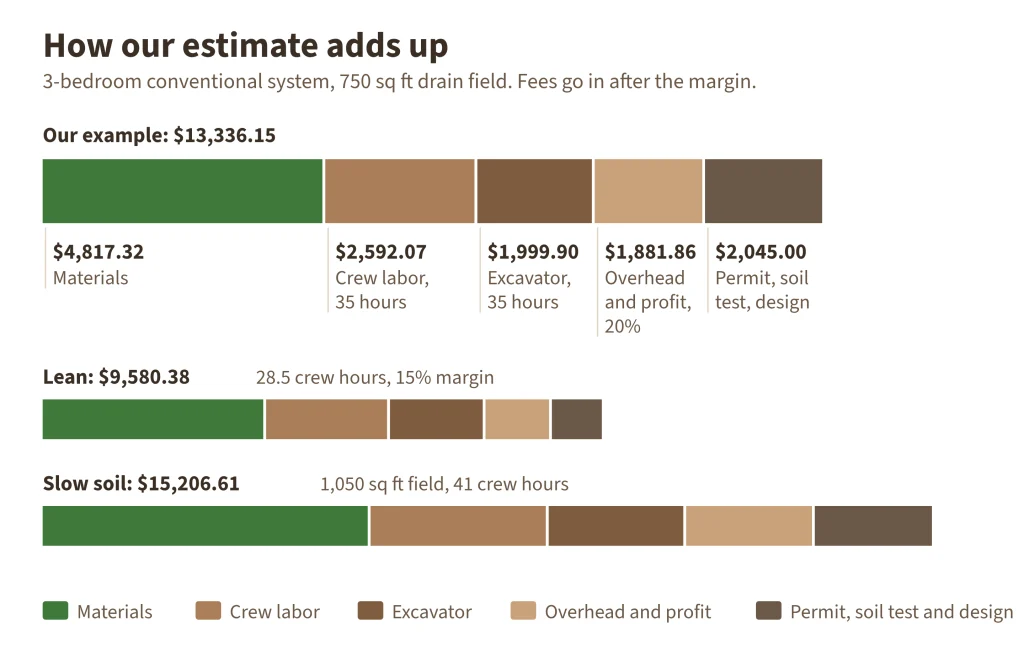
Materials come to $4,817.32. The tank is a third of that, and the rock is almost another third.
Crew and excavator
We found no public source for how long a septic install takes, so the hours are our assumption. We allow 12 crew hours for the tank and pipe, 6 per 100 ft of trench (15 for 250 ft), and 8 for grading, cleanup and the inspection visit. That’s 35 hours for a crew of one equipment operator and one laborer, a bit over two working days.
Operating engineers earned a median of $59,850 a year in May 2025 (BLS), or $28.77 an hour by our division by 2,080 hours. Construction laborers earned a median of $47,120 a year, which BLS’s wage tables give as $22.66 an hour. Those are workers’ wages, not what a firm bills. In June 2026, construction employers paid $51.96 in total compensation for every $36.13 in wages, so we multiply wages by 1.44 to cover benefits and payroll taxes: ($28.77 + $22.66) × 1.44 = $74.06 an hour for the crew. Labor: 35 × $74.0592 = $2,592.07.
For the machine we use FEMA’s 2025 disaster-work rate for a hydraulic excavator up to 45 hp: $57.14 an hour. FEMA says its rates cover depreciation, overhead, maintenance, repairs and fuel, but not the operator. Running the machine for all 35 hours (our assumption) gives $1,999.90. As a check against HomeGuide’s figure: excavator plus operator comes to $57.14 + $41.43 = $98.57 an hour before margin, just under HomeGuide’s $100 to $300.
Overhead, profit, fees and the total
Overhead and profit are 20%, our assumption, applied to materials, labor and equipment. Insurance estimates often use 10% overhead plus 10% profit, which a 2013 bulletin from FEMA’s flood program called the typical charge. Because FEMA’s equipment rate already contains some overhead, this may count a little twice. Fees are added afterward, at cost. The permit uses Mason County, Washington’s 2026 schedule: $570 for an individual permit plus $275 for the installation, or $845. The soil test and design are $1,200, our assumption, inside Angi’s $700 to $2,000 for perc and soil tests.
| Line | Our example | Lean | Slow soil |
|---|---|---|---|
| Materials | $4,817.32 | $3,808.98 | $5,588.84 |
| Crew hours | 35 | 28.5 | 41 |
| Crew labor | $2,592.07 | $2,110.69 | $3,036.43 |
| Excavator | $1,999.90 | $1,628.49 | $2,342.74 |
| Overhead and profit | $1,881.86 (20%) | $1,132.22 (15%) | $2,193.60 (20%) |
| Installed price before fees | $11,291.15 | $8,680.38 | $13,161.61 |
| Permit, soil test and design | $2,045.00 | $900.00 | $2,045.00 |
| Estimate | $13,336.15 | $9,580.38 | $15,206.61 |
“Lean” uses rock at $25 a ton, one riser, no effluent filter, 28.5 crew hours, a 15% margin, a $200 permit (Etowah County, Alabama’s conventional application fee from 1 September 2026) and $700 for the soil test and design. “Slow soil” is our example with Nebraska’s 1,050 sq ft field for soil at 50 to 60 minutes per inch: 350 ft of trench and 54.4 tons of rock.
About a third of our example’s total is the drain field: rock, perforated pipe, and 15 hours of crew and machine time, plus margin, comes to about $4,680. The tank, filter, risers and 12 hours of setting work, with margin, come to about $4,720. Fees are $2,045. The rest is the solid pipe, distribution box, fittings and grading, with their margin.
How the calculator works
Enter the drain field area from your design (or the 750 sq ft example), the trench width and rock depth, and your prices. The formulas are:
- Feet of trench = field area ÷ trench width
- Drain rock in tons = field area × rock depth in feet ÷ 27 × tons per cubic yard
- Perforated pipe = feet of trench ÷ 10, rounded up, × price per length. Solid pipe = feet ÷ 10, rounded up, × price per length
- Materials = tank + filter + risers + box + both pipes + rock + small parts
- Crew hours = tank hours + feet of trench ÷ 100 × hours per 100 ft + grading hours
- Crew labor = crew hours × (operator wage + laborer wage) × 1.44. Excavator = crew hours × hourly rate
- Estimate = (materials + labor + excavator) × (1 + overhead and profit %) + permit + soil test and design + other quoted work
Fees and other quoted work go in after the margin, because they are either passed through at cost or already priced with the contractor’s margin. Use the “other quoted work” box for tree or rock removal, a pump tank, a longer sewer line, landscaping and sales tax. The calculator prints an estimate, not a price you’re owed, and it doesn’t check your design against any rule. Your permitting office and designer decide what the system must include.
Why our estimate is higher than most published ranges
- The drain field is real tonnage. A 750 sq ft field with 12 inches of rock needs about 39 tons of stone, and neither Angi’s nor HomeGuide’s breakdown has a line for it. Gravelless chambers or pipe can replace the rock where your state allows them. Nebraska’s permit, for one, sets an effective width for them. We couldn’t find a public chamber price to compare.
- Fees are included. Our $2,045 for the permit, soil test and design is 15% of the total. HomeGuide’s conventional breakdown includes $1,000 to $1,500 for engineering, permits and inspections. Angi gives permits ($450 to $2,300) and soil tests ($700 to $2,000) as separate costs, so its range may leave them out.
- Our hours are assumptions. If a practiced crew does the job in 25 hours instead of 35, the estimate falls by about $1,570.
- Labor is a smaller share in our build-up. Angi says labor is 50% to 70% of the total. In our build-up, crew and machine together are 40% of the installed price, so materials take up more of it than Angi suggests. Either crews bill much more per hour than BLS wages and FEMA’s rate imply, or the published “labor” includes the firm’s overhead and margin.
- Dates and mix. Bob Vila’s page is from January 2023 and HomeGuide’s from September 2025. Angi’s range blends simple systems with mounds and aerobic units, so it tells you little about any one design.
We can’t say which number will be closer to your quotes, because none of the published pages shows its work. What you can do is put each quote’s lines into the calculator and see where they differ.
What moves the price up or down
| Change from our $13,336 example | Effect on the estimate |
|---|---|
| Slower soil: 1,050 sq ft field instead of 750 | About $1,870 more |
| A 90 hp excavator at FEMA’s $95.01 instead of $57.14 | About $1,591 more |
| Overhead and profit at 30% instead of 20% | About $940 more |
| No risers, lids left at tank depth | About $804 less, if your permit office allows it. Digging to the lids at every pump-out costs money later |
| Drain rock at $25 a ton instead of $40 | About $700 less |
| Permit at $200 (Etowah County, AL) instead of $845 (Mason County, WA) | About $645 less |
| Soil that fails a conventional design | A different system: see the next section |
The biggest swing is the soil. Nebraska’s general permit, cited above, requires the bottom of a trench to be at least four feet above the seasonal high groundwater table, and it doesn’t cover soil slower than 60 minutes per inch. A lot that can’t meet rules like these needs an engineered design. Our guide to what a perc test is and what it costs covers that step, and the drain field guide explains how the field is sized and laid out.
Permit, soil test and design fees
Fees are set by each county or health district, so there is no national figure. Three 2026 schedules show how much they vary:
| Office | Fee for a new system | Schedule |
|---|---|---|
| Inyo County, California | $452 conventional; $634 alternative design | Effective 1 January 2026 |
| Mason County, Washington | $570 individual permit plus $275 installation | 2026 Environmental Health fee schedule |
| Etowah County, Alabama | $200 conventional application (up from $100); $200 engineered | New fees from 1 September 2026 |
These are the health office’s fees only. The soil evaluation and the design are paid separately, either to the county where its staff do the work or to a private designer or engineer. That’s why our calculator keeps them on separate lines. If you’re buying land, the soil test comes first: it decides whether a conventional system fits at all, and so which price range applies. Ask the permitting office what it needs before it will issue a permit, and what each inspection costs.
Mound, aerobic and other systems
Our calculator prices a conventional gravity system only. For other designs, here are the two cost guides’ published estimates side by side. They disagree most on the expensive systems:
| System | Angi, Oct 2026 | HomeGuide, Sep 2025 |
|---|---|---|
| Conventional (anaerobic) | $3,000 to $8,000 | $3,500 to $8,500 |
| Chamber | $5,000 to $12,000 | $4,000 to $11,000 |
| Drip | $8,000 to $18,000 | $6,500 to $15,000 |
| Sand filter | $7,000 to $18,000 | $15,000 to $25,000+ (recirculating) |
| Aerobic treatment unit | $10,000 to $20,000 | $20,000 to $40,000+ |
| Mound | $10,000 to $20,000 | $25,000 to $50,000+ |
| Evapotranspiration | $10,000 to $15,000 | $10,000 to $15,000 |
For a mound, the two guides’ ranges don’t even overlap. Our conventional build-up already passes $13,000, so the higher range looks more plausible to us. That’s a judgment, not a measurement. Our mound system guide explains what a mound includes and why soil and groundwater lead to one.
What a quote should list
- Tank size in gallons, material, number of compartments, and who delivers and sets it. Ask whether your state or county requires a listed or approved tank model
- Effluent filter make and model, and risers: how many, how tall, and how the lids are secured
- Drain field: square feet of trench bottom, number and length of trenches, trench width, and rock depth or the gravelless product used
- Tons of drain rock and its size, plus the fabric over it
- Feet of solid pipe from the house, and whether connecting at the house is included
- Who arranges and pays for the soil test, design, permit and inspections
- Grading, topsoil and seed, and whether removing trees, rock or spoil is extra
- How machines will stay off the drain field area. Nebraska’s permit bans driving on it when soil percolates slower than 10 minutes per inch
- Warranty: what it covers and for how long
Put the quote’s prices into the calculator. A quote well above your estimate isn’t necessarily wrong, since access, rock, region and design all add real cost. But the installer should be able to show which lines are higher, and why.
Red flags
- One lump-sum price with no tank size, field area or rock tonnage
- An offer to start before the permit is issued, or to skip an inspection
- A field size that doesn’t match the approved design
- No plan for lid access. Washington’s health department says to use bolts, screws, or other locks to secure the lids, and warns that people do fall into septic tanks
- A driveway, parking spot or shed planned over the tank or field. The same Washington page says never to drive or park on top of a septic system
Help with the cost
Most programs help with repairing or replacing a system, not with a first install on new construction. Three examples: USDA’s Section 504 program offers loans up to $40,000 and grants up to $10,000 to low- and very-low-income homeowners in eligible rural areas, with grants limited to very-low-income owners aged 62 or older who use them to remove health and safety hazards. Massachusetts offers a tax credit of 60% of design and construction costs to owners required to repair or replace a failed system, up to $4,000 a year and $18,000 in total, according to the state’s tax expenditure budget. Suffolk County, New York, offers grants of up to $20,000 toward nitrogen-reducing systems. Each has its own eligibility rules, and funding isn’t guaranteed. For a system that is failing now, see what septic tank replacement costs.
Sources and notes
SepticPlain doesn’t install or pump septic systems, has no crews, and takes no fees from contractors or sellers. We build estimates from public data. The retailers named above were chosen because their prices were publicly readable. We don’t recommend them, and other sellers may charge less. Prices, wages, fees and published ranges change, so check them against your own quotes. Your local permitting office and a licensed designer or installer decide what your site needs. This page is general information, not professional, legal or financial advice.
Sources checked on 3 November 2026.
Formulas and sources
- Feet of trench: NDEE Title 124 booklet with Septic Tank and Subsurface Leach Field General Permit GTS220000 (June 2022), sections 17 and 19, Table 5
- Drain rock, cubic yards: NDEE Title 124 booklet with Septic Tank and Subsurface Leach Field General Permit GTS220000 (June 2022), sections 17 and 19, Table 5
- Drain rock, tons: Arithmetic on the reader's own entries, no outside figure
- Drain rock cost: Arithmetic on the reader's own entries, no outside figure
- Perforated pipe cost: Mill Supply Co.: 4 in x 10 ft perforated PVC sewer pipe, ASTM D2729, $14.93 (seen 3 Nov 2026, retailer)
- Solid pipe cost: Mill Supply Co.: 4 in x 10 ft SDR 35 solid PVC sewer pipe, belled, $22.43 (seen 3 Nov 2026, retailer)
- Risers cost: Septic Solutions: Polylok 24 in x 20 in complete riser package 24PRP-18, $335 (seen 3 Nov 2026, retailer)
- Materials: Arithmetic on the reader's own entries, no outside figure
- Crew hours: Arithmetic on the reader's own entries, no outside figure
- Employer cost per crew hour, operator plus laborer: BLS Employer Costs for Employee Compensation, June 2026, construction (Table 4)
- Crew labor: BLS Occupational Outlook Handbook: Construction Equipment Operators (May 2025 wages)
- Equipment: FEMA Public Assistance Schedule of Equipment Rates 2025, cost code 8280, hydraulic excavator to 45 hp, $57.14 an hour
- Materials, labor and equipment: Arithmetic on the reader's own entries, no outside figure
- Overhead and profit: FEMA NFIP Bulletin W-13064: Allowance for Overhead and Profit (2013)
- Installed price before fees: Arithmetic on the reader's own entries, no outside figure
- Permit, soil test and design: Arithmetic on the reader's own entries, no outside figure
- Estimated total: Arithmetic on the reader's own entries, no outside figure
- Employer cost per dollar of wages, construction (1.44, as of 2026-11-03): BLS Employer Costs for Employee Compensation, June 2026, construction (Table 4)
Sources
- Angi: How Much Does a Septic System Cost? (updated 14 Oct 2026, lead-generation site)
- HomeGuide: Septic Tank System Cost (22 Sep 2025, lead-generation site)
- Bob Vila: Septic Tank Cost (updated 26 Jan 2023)
- EPA: SepticSmart homeowner guide (2012)
- EPA: Frequent Questions on Septic Systems (updated 11 Mar 2026)
- Washington WAC 246-272A-0232: septic tank minimum volumes (effective 1 Apr 2025)
- Minnesota Rules 7080.1930: septic tank capacity
- New York State DOH: 10 NYCRR Appendix 75-A
- Pennsylvania Code 25 Pa. Code § 73.31
- Florida F.A.C. 62-6.008, System Size Determinations (Cornell LII reproduction)
- TCEQ RG-472: On-Site Sewage Facility Rules Compilation (May 2017)
- Nebraska NDEE: Title 124 booklet and Septic Tank and Subsurface Leach Field General Permit GTS220000 (booklet Ver. 02.2026; permit effective 27 Jun 2022)
- Septic Solutions: septic tanks, IM1060 1,060-gallon plastic tank (seen 3 Nov 2026, retailer)
- Sponsored post: Pennsylvania precaster's septic tank prices (19 Nov 2025)
- Septic Solutions: PL-122 effluent filter (seen 3 Nov 2026, retailer)
- Septic Solutions: 24 x 20 in complete riser package (seen 3 Nov 2026, retailer)
- Septic Solutions: 4-hole distribution box (seen 3 Nov 2026, retailer)
- Mill Supply Co.: 4 in x 10 ft perforated PVC pipe, ASTM D2729 (seen 3 Nov 2026, retailer)
- Mill Supply Co.: 4 in x 10 ft SDR 35 solid PVC pipe (seen 3 Nov 2026, retailer)
- USGS Mineral Commodity Summaries 2026: Stone (Crushed)
- Defiance County, Ohio Engineer: 2026 crushed aggregate bid tabulation (9 Feb 2026)
- BLS Occupational Outlook Handbook: Construction Equipment Operators (May 2025 wages)
- BLS Occupational Outlook Handbook: Construction Laborers and Helpers (May 2025 wages)
- BLS Employer Costs for Employee Compensation, June 2026, Table 4
- FEMA Public Assistance Schedule of Equipment Rates 2025
- FEMA: Schedule of Equipment Rates, what the rates include
- FEMA NFIP Bulletin W-13064: Allowance for Overhead and Profit (8 Oct 2013)
- Mason County, Washington: 2026 Environmental Health fee schedule
- Inyo County, California: Environmental Health 2026 fee schedule
- Alabama Department of Public Health, Etowah County: environmental fee schedule (from 1 Sep 2026)
- Washington DOH: Septic System Lid Safety
- USDA Rural Development: Single Family Housing Repair Loans and Grants
- Massachusetts FY2025 tax expenditure budget, item 1.606: septic credit
- Suffolk County, New York: septic improvement grants